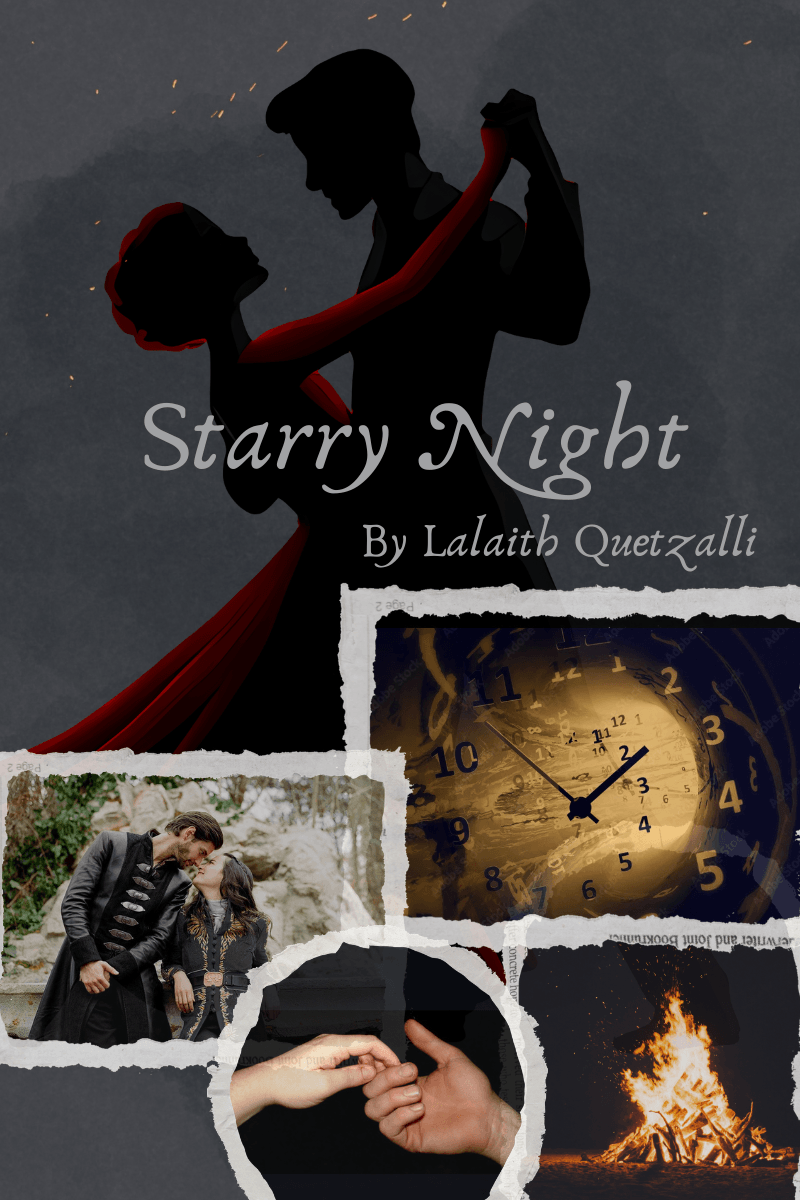
Title: Starry Night
Author: Lalaith Quetzalli
Fandom: Shadow and Bone
Genre: Angst, Fantasy, Pre-Relationship, Romance, Time Travel
Relationship(s): The Darkling | Aleksandr Morozova/Alina Starkov, Background Relationships
Content Rating: PG-13
Warnings: Violence-Graphic, Racism, Murder, Implied Hate Crimes, Referenced Domestic Abuse, Referenced Child Abuse, Referenced Kidnapping, Minor Character Death, Referenced Slavery, Violence – Canon Level, Religious References, Brief Implied Suicidal Intention/Ideation.
Author Note: On the last warning listed. In the end of the Prologue the female lead participates in a ritual. It’s never fully specified what would happen to her, though the implications are clear. It’s also made clear that she’s doing it willingly. No suicide actually takes place (also, that word is never used in the story itself).
Word Count: 69,261
Summary: Aleksandr was right and Alina’s not even surprised. She once thought that it was cruelty, evil, that made ‘wanting to destroy’ his first choice for everything; now she knows the truth: it was sadness, and defeat, and loneliness. It was losing so much and so many. Alina’s tired of losing. She knows now, she’d do things so differently, if she had another chance. But it’s not like it’s possible to change the past. Time-travel just doesn’t exist… right?
Artist: Librarycat9
Prologue.
The cell is dark, and damp, and cold. It’s probably a good thing Alina has never been afraid of the dark; or if she ever was, it was so long ago she no longer remembers. Even before the shadows became so inextricably connected with him (regardless of whether he was around to be controlling them or not, in her mind all shadows were a part of him to some degree) Alina found the darkness easy, cozy, almost… comforting. Being kept away from the sun for so long has weakened her to the point that she isn’t sure there’s any need for the shackle chaining her to the wall anymore. She’s become so weak… sickly so. Then again, it’s not like it’s the first time. She was sick for so many years while hiding her status as a Grisha (long enough that there came a time when she forgot she was hiding and convinced herself that she just wasn’t Grisha at all…).
So she’s in a dark, damp and cold cell, shackled to the wall and weak and sickly from being kept away from the sun. There’s not even a window in her cell, though she’s pretty sure she’s underground, so that might explain that. She wonders if the dungeon-like place might even be part of the White Cathedral, it’s not like she ever fully explored the place… What does it matter anyway? It’s not like she’s getting out any time soon, if ever.
The Darkling was right, and why is she even surprised by that? But no, if she’s honest with herself, there’s a part of her that was never surprised by it. She knows that many always saw her as a young, impressionable, naive little girl, but she’s far from that. Alina’s a half-Shu orphan who grew up in an orphanage that was utterly dependent for its existence on a Duke’s charity. An orphanage where half the children had lost their parents to Shu attacks on the border towns. How did people think she grew up, considering those things? But truth is, most people never stopped to think about such things, most people never saw beyond her status as the Sun Summoner; and before that, before she was ever known to be Grisha, she was always the Shu-girl, the orphan, the outsider, the waif nobody wanted…
Even the First Army didn’t want her. Military service is compulsory in Ravka; everyone, both men and women are expected to serve a minimum of three-to-five years, depending on their talents, position and specific circumstances at the time of their service (like, whether they happened to be actually fighting against Fjerda/Shu-Han or someone else at the time, or if there’s currently a lull in hostilities).
There are a few ways to avoid service, of course. Most noble heirs for example, rarely serve, and if they do, they’re never sent to the front (after all, what would their Houses do, if they were to lose the next lord?). Those who join the Church of the Saints don’t, either, unless it’s as medics or to bring the Faith to those serving. The last consideration are those too sickly or with a severe enough disability to keep them from passing Basic. The problem on that front is that, for orphans like Alina (and Mal, and so many others), the First Army is the only way for them to make something of their lives. Unless they’ve been especially lucky and been adopted, or at the very least apprenticed under someone with no one else to teach their particular trade or skill to, then the First Army is their one chance to earn some coin, enough to hopefully make a start on a life, either paying someone to teach them a trade or perhaps put a downpayment on a farm, a ship or something else, once they’re finished with their service (if they live that long); or in most girls’ cases, the money is usually used for a dowry.
The First Army did not want Alina. She was seen as too weak and sickly to be able to finish Basic. When she turned sixteen, she tried to sign-up, like her first friend Mal, and a few others, but she was rejected. It was Ana Kuya’s (the orphanage’s matron) idea that she ought to learn how to do something else; something that would be useful enough for the First Army to want her, but not something they’d need her on the frontlines for. Medicine would have been the most useful talent, but the orphanage’s budget was tight enough already, they did not have the kind of money needed to get someone to teach Alina to be a medic; so she turned to mapmaking instead. Between the inclement weather in some areas of Ravka, the subtle but not insignificant shift in the Shadow Fold every so often, and the constant armed conflicts (at times not just in the borders) lines and landscapes kept being redrawn, and the army always needed to have maps they could trust. Alina always had a knack for drawing, and by the time she turned eighteen she was so good the army couldn’t not take her. And thus she became a mapmaker.
Alina’s always known what it’s like to not fit in, to be different from everyone else. The orphanage wasn’t the only place where her Shu looks gave her trouble. The First Army was the same. Her looks, coupled with her sickly state, and the fact that despite this she was still clearly the most talented of them all made things harder than they could have been, had she been just like everyone else…
It’s one of the reasons she’d such a hard time, when she was found out to be Grisha, when she first came to the Little Palace. After growing up listening to all sorts of stories about Grisha, all the ways they were different, odd… almost unnatural… It didn’t make things easy for Alina. And of course then there was the fact that her being a Sun Summoner, rather than just any other sort of summoner, any other sort of Grisha, meant that she’d be hunted, probably for the rest of her life. Both by those who wanted her dead, and those who wanted her for themselves (back then she wasn’t actually sure which one might be worse, nowadays… well, she now knows death isn’t the worst fate).
Even when she could, somewhat, get over the fact that she was Grisha rather than otkazat’sya, there was the fact that even among Grisha she just didn’t fit. A part of her (a tiny, childish and half-terrified part) had wanted to believe that proving to be Grisha, being in the Little Palace, would mean that she’d finally have a home, a place where she could belong. But it wasn’t to be so. Even when she chose to wear Etherealki blue instead of the black the general offered her, there were always those quick to remind her that she wasn’t like everyone else. That she’d never fit…
The General scoffed at her not wanting to stand out, wanting to be like the others, but was it truly so wrong? Wanting to belong? To have a home?!
And then… then everything went so, so very wrong, in so many ways… When she stood face to face with Baghra, in those dark tunnels beneath the palaces, when the woman told her that General Kirigan (her almost lover!) was the Black Heretic, was a monster seeking to enslave her, and worst of all, that all his sweet words, his vulnerability before her, were nothing more than a lie, an act meant to draw her in, to chain her to him… Alina used to believe nothing could ever hurt more than that revelation. It was such a betrayal, what could possibly be worse than that…? A feeling that was only compounded when the Darkling went and put that collar on her, took control of her, of her light, her soul… Used her like she wasn’t a woman, merely a tool, a weapon (one that was used to kill so, so many)… What could possibly be worse than that?!
And then Alina was forced to go and rip out her own heart… for the good of Ravka! She might as well have plunged that Grisha steel through her own heart at the same time it went into his, for all the good it did her afterwards.
Thing is, as bad as things might have gotten throughout the war, regardless of all the yelling and the insults, of the way they so willingly attacked each other… Alina never actually imagined there ever being a day when Aleksandr just wouldn’t be there anymore. She knew he had to be stopped, and who else could possibly stop him but her, and yet… Somehow it never occurred to her what that meant. (She was always good at denial, wasn’t she? Even if it got her nowhere).
Alina killed Aleksandr… the Darkling. She killed the man who, despite all the bad he’d done, not just to Ravka as a whole, but to her, despite all that, he was still the man she loved more than anyone else in the world (more than she ever thought she loved Mal) with her whole heart and soul. And still she killed him, because if there was one thing that he taught her, and taught her well, it was that Grisha must be protected, and Ravka as a whole; and he was a threat to both.
The last betrayal… Alina couldn’t say she was surprised, not really. Regardless of whatever friendship and perhaps even… affection, Nikolai might have for her, his desire for a throne, for the throne he believed he was owed, would always be stronger. It didn’t even matter that he turned out not to be a Lantsov in the end, he was raised a prince, and even as a second son, he was raised to believe that the throne belonged to his family.
Alina wouldn’t have even minded his betrayal, if it had been about Ravka. Everything changed after she killed A… the Darkling. Or no, it wasn’t then. Or rather, things changed for her, in her mind and heart then, but people didn’t start acting differently until later, when Nikolai’s coronation was abruptly interrupted by a heartrender high on jurda parem. So many people died, Nikolai himself came dangerously close. And while that in and of itself would have been bad enough (it’s certainly lead to Grisha becoming feared and hated all over again… not that things ever were that different, hard as she tried); the real issue was the fact that when Alina managed to push past the tearing pain inside herself and created a Cut, it was one made out of shadows instead of light…
She knows most people haven’t trusted her since then. It’s not that Alina isn’t the Sun Summoner anymore, she is. But nowadays the shadows come to her just as easily as the light, sometimes even more so. She doesn’t know if the shadows are some sort of curse, the price she must pay for using Merzost to bring Mal back or… there’s a part of her that cannot help but wonder if perhaps these are His shadows, a part of her Aleksandr that he left with her, his way of keeping his promise to always be right by her side… There’s no way she could ever say that to anyone though, they’d either pity her, think her crazy, or be even more horrified by the whole thing than they already are. Then again, she’s not sure her situation can be any worse than it already is! (She’s been betrayed, put in a cell, cut off from everything and everyone, even the sun!)
When they first came for her, Alina was confused. The Apparat arrived at her rooms at the head of a dozen royal guards. He claimed that he was there to take her to the Church for a cleansing ritual, that she had been corrupted by the Darkling and her light needed to be purified. Alina didn’t think anything the Church could do would change her circumstances (and she didn’t want it to), but she still followed the Apparat. Things were already complicated enough, she didn’t want to do anything that might result in Grisha having more difficulties than they already did. It was until they started walking down the hallway that it occurred to her to wonder at the fact that there were a full dozen guards escorting. Why? What did they think she was going to do?!
At first Alina was taken to a Church, where she was kept locked in isolation day and night, except for the times when a dozen guards would escort her to service three times a day. She was made to wear nothing more than a coarse off-white robe and no shoes. She was also denied food often, and only given enough water to survive. When the thin skin of her feet (as strong as she might have become, since discovering she was Grisha, it’d take more than a year or two to erase the long-term damage the wasting sickness left on her body) tore and she started leaving bloody footprints on the Church’s floors, these were treated as signs of her penance, proof that she was ‘walking the path to her redemption’.
Alina made a point to never complain, to never ask for more than she was given. The Apparat spun it all to fit with his own narrative of course, and Alina just kept telling herself that she was doing it for the Grisha. That she endured all she did to protect them, the last thing she wanted was to give people even more reason to turn on Grisha.
Eventually there came a time when Alina could no longer walk, she could barely stand. By the time she was moved from the isolated room to that sunless dungeon she had no strength to resist. She was barely even aware. She only noticed the shackle on her when she opened her eyes and the darkness was so deep she couldn’t help but instinctively call on her light, she barely got the tiniest sphere, just enough to see herself and her surroundings.
She won’t lie (at least not to herself), there was a part of her that wondered if she would be tortured. Perhaps even used and abused in the ways she knew men enjoyed doing to girls. But that never happened. In fact, it was almost like people forgot she was there most of the time, or perhaps it was that so few knew she was there… She was given a little water every other day, and food only about once a week, always nothing more than stale bread. She was pretty sure that if it weren’t for what little access she still had to the shadows, she’d have died before long.
‘The little science feeds us’ is something she was taught in the Little Palace, and that seemed to be true enough. Away from the sun, and being so weak already, it didn’t take long before she fully lost the ability to call on the light. It’s still there, she can sense it deep inside her; but it’s almost like back when she’d just arrived at the Little Palace, before she learned to summon on her own, no matter how hard she tried, she couldn’t make it come. The shadows on the other hand… they come, and while they make little difference in the already near absolute darkness of her surroundings (the only thing keeping the smallest illumination being some kind of ore in the stones surrounding her that seems to make them almost glow, though very dimly. The shadows don’t seem to feed her much, whether that’s because they aren’t truly hers, or due to how little access she has to her abilities at all; but at least it’s enough to keep her from dying (some times, in her darker moments, she can’t help but wonder if that’s a good thing at all). It’s not that she wants to die, not really but… is she even living at all? Trapped in a dark hole, away from everything and everyone?
The Apparat does show up eventually bringing her news that shatter what little is left of her soul:
“You’re dead,” he informs her. “Officially. It was declared a fortnight ago. Sankta Alina, the Savior of Ravka, fought a battle against the curse the Darkling left upon her and while she was victorious, it came at a cost, that of her own life. It’s a tragedy, to be sure, but you should be proud of yourself girl, Ravka will remember you forever…”
No, they wouldn’t. They wouldn’t remember Alina Starkov, the Grisha, the once-mapmaker, the half-Shu orphan girl who tried so hard… No, all the people would remember would be Sol Koroleva… Alina remembers finding out that most of the Saints the Church talks about were in fact Grisha, good Grisha who used their skills to protect people, sometimes entire towns, and it cost them their lives. The stories always talk about their sacrifices, their tragic deaths… They’re never treated as real, as human, and certainly not as Grisha (the Church certainly wouldn’t be able to condemn Grisha as unnatural if they admitted most of their saints were such, could they?). Alina wonders how many of the so-called Saints did not die as the stories told, who might have survived their greatest works, only to be then killed by ungrateful otkazat’sya… She wonders why she even cares, it’s not like it makes a difference at all! She’s going to die, she’s as good as dead already, and no one will ever know, no one will ever care for Alina, and only remember Sol Koroleva.
The whole thing just makes Alina hate, more than she ever believed she could. She hates the Apparat, the slimy little man who all along wanted her to die, because saints are only good when they’re dead (one cannot make up a narrative about someone still alive, after all, as they might easily contradict any story told about them). She hates her so-called friends, who claimed to care so much for her, and yet they’ve all abandoned her (Genya, Zoya, Adrik, Nadia, Tamar, Inej, Mal…) every single one of them! And then there’s Nikolai…
The thing about Nikolai is that, if Alina still believed that he’s what’s best for Ravka, that he’s a good King, for Grisha and Non-Grisha both, that he’ll be fair to all the people… But she doesn’t believe that. She hasn’t believed that since even before she was taken to be ‘cleansed’. The only reason she stayed as long as she did was out of hope that she might still be able to protect her people, protect both Grisha and non-Grisha; because Alina knows, as bad a king as Nikolai might be for non-Grisha, he’s not doing much better for otkazat’sya in the end. Ravka is heading down a dark path, to ruin and chaos, and the man is next to useless, doing nowhere near enough to stop it!
If the Darkling were still around he’d have never allowed things to get as bad as they have. Hell, things weren’t as bad even with the previous Lantsovs in power (though again, that might have been because of the General…).
Alina just misses him, misses Kirigan, but more than that, she misses her Aleksandr so much… She cannot help but think that if she’d known then what she does now, things would have gone so very differently. She’d have never run away from him, would have given him a chance to tell her his side of things. But more importantly, she’d have tried so hard to make things work, to make him listen to her, as much as she listened to him, would have sought to have them compromise… She understands now that while the Fold might have been a terrible thing, it also served a purpose, in a way. She doesn’t know if she’d want it to stay indefinitely, but neither should it have been taken away so abruptly, and without a plan for securing the borders, for securing Ravka, for protecting Grisha, ensuring they’d have a future, a good one…
And beyond all that, beyond plans for war and peace, for Grisha in particular and Ravka as a whole. She misses her Aleksandr, misses the certainty that she didn’t have to be alone anymore… She’s so, so alone now…
xXx
Alina doesn’t see the attack coming. Things have gotten to the point where she seems to spend more time asleep than she does awake. And even the times when she’s awake she’s half-disconnected from reality, talking to herself (and wishing she were talking to him instead). Suddenly the door to her cell slams open and light comes pouring in, so bright and sharp Alina reacts instinctively, calling on shadows (calling on Aleksandr) to shield her. She thinks she might hear someone gasp, but before she can even think about trying to lower the shadows enough to look… someone’s taking over her body. She loses consciousness before she can so much as call out.
When she next wakes up things have changed, and not at the same time. She’s in a very different room this time, laying on an actual bed instead of an old cot. The room is dark, but not the dark of her old underground cell, but that of a room, one with actual windows; the darkness is caused by the fact that it seems to be the middle of the night. Also, someone’s clearly gone through the effort of washing her body and dressing her in a simple but very soft cotton nightdress. Even her hair is clean, shorter than it was before but still. Her feet are sore but healed. On the other hand, there are bars on the windows, and there’s a cuff of some sort around her wrist. She doesn’t even need to do a thing to know it’s meant to limit her summoning. Still, it’s an improvement. Also, there’s a glass and a pitcher of water, along with some bread that, while old clearly isn’t moldy, not even stale! There’s even a little fruit!
Knowing that it’ll be a mistake if she gorges herself after so long without solid food and barely even water, Alina pours a glass of water for herself and starts taking small sips of it. She considers trying the bread but her stomach rebels at the mere thought, so she takes tiny pieces of the fruit instead.
Her attention is drawn entirely away from the water and food when she feels a warmth at her core, in the distance she can see the sky beginning to grow lighter… dawn’s approaching.
It’s been such a long time since Alina’s seen the sun… She’s crying before she even realizes it.
The window of her room points east, and it looks like she’s in some sort of cabin either in the middle of nowhere, or near the edge of whatever town or village she’s in. Whichever the case, there’s nothing but a wide field that she can see outside, nothing to block her sight of the sun as it rises over some hills in the distance. Almost without thinking it, the moment the sun truly hits her, she summons, she doesn’t seek to create a sphere, or anything really, just letting a soft glow manifest around her.
She doesn’t realize she’s not alone anymore until the person speaks up:
“So you’re still the sun summoner then,”
Alina doesn’t flinch. While she’s surprised that someone entered the room without her noticing, she doesn’t see the point to being afraid. If this person, if any of the people involved in her rescue, wanted her dead, she’d be dead already.
“Yes,” she says simply, not turning around, she doesn’t want to look away from the sun just yet.
“And yet you can summon shadows as well,” the other person says.
“Yes,” she doesn’t bother trying to hide it, what would be the point?
“How?” the man demands sharply.
“I have no idea,” she answers with a shrug.
“Don’t lie to me!”
“I’m not lying. I have theories, but no way to prove or disprove any of them. Is it because I used Merzost to bring back my oldest friend? Is it because I killed him?” she doesn’t say his name out loud, she cannot. “Is it supposed to be a curse, like the Apparat claimed? Or is it just him trying to protect me even though I do not deserve it…?”
“Alina…”
“Hello Fedyor…”
It’s clear the heartrender wasn’t expecting her to say something like that, any of it. He has a hard time proceeding afterwards.
Alina learns what’s going on eventually. Fedyor is part of a new group. The Starless Order, they call it. They’re all Grisha who still believe in General Kirigan, who keep fighting to protect Grisha, like he would have wanted them to.
It’s not easy. Nikolai has apparently been trying to make some sort of deal with Shu-Han, promising to marry one of the Empress’s granddaughters, and the longer those negotiations go on, the worse things get on the southern border. And as if that weren’t enough, there’s the matter of Fjerda, who seems to take the Tsar’s intention to marry a Shu princess as an excuse to increase their own attacks on the north. And it’s not even just about kidnapping and killing Grisha and their families, but at least two villages and over half a dozen farms have been razed to the ground.
And what is the Tsar doing about it? Absolutely nothing. Alina wonders if he even knows (the more uncharitable part of her wonders if he even cares…).
It takes a little while, but eventually Alina learns that it’s no coincidence she was rescued. While not many believed the rumors that the sun summoner was trapped in a dark cell in the catacombs of the White Cathedral, a group of volunteers from the Order decided to take the chance. At first Alina thinks they expect her to fight with them, if not lead them. As it turns out, it’s not that at all…
“So you think these are actually his shadows, then?” she asks after the whole thing is explained to her, at the same time she summons a few shadows, playing with them in between her fingers.
“As you’ve already said, so do you,” Fedyor reminds her.
Yeah, she does. She used to consider it wishful thinking, and yet… she’d have never so much as considered the kind of implications the Order has.
“And you think that because of this, I can bring him back,” she continues.
She thinks about telling Fedyor how Aleksandr asked that there be nothing left of him, nothing others could use, either as amplifiers, or to bring him back. But at the same time, she can’t… because she knows Fedyor, she knows his loyalty is, always has been, and will always ultimately be to Kirigan, and if she tells him he didn’t wish to be brought back then… then he won’t do it, and Alina cannot handle existing as she does anymore!
“You have my sympathies for what comes next, when you realize that what you’ve done solves nothing. The world doesn’t need a Saint to protect it. It needs a monster. And while I remain… Let me be your monster.”
“You think that after everything, I’d still stand by you?”
“There is no light without darkness. Without me, you have no counter, no balance. Let me carry the hatred of this world.”
“Hatred. Because of the choices you made.”
“Choices you too will make… in time.”
“I will never walk your path.”
“I know you believe that now. But soon… Soon you will have no equal. The years spent alone will grind you down, they will harden you. And who will be there to shield you from it? Who will be there to save you?”
She can almost hear the words still, inside her head, as if the whole exchange were happening in that very moment. Can almost see him, standing before her, bent yet unbroken. There’s so much she wishes she had known, had understood… That she had understood him. She never had the chance, never gave the both of them the chance. She was too naive, too trusting of the wrong people and later refusing to even listen no matter how hard he tried… She failed him, and she failed herself.
Truth is he was so strong, so much more than she’ll ever be. Standing tall, holding on, fighting for so long, all alone… She cannot do it.
“I’ll do it,” is all she says in the end.
xXx
It’s a rather simple ritual, though one with a lot of ingredients: a personal possession (his blade-ring), a representation of his House (one of his banners), one of his bloodline (one of Bagrah’s bones, given to Fedyor to serve as an amplifier), his blood (on some preserved bandages), the blade used to kill him, and what remains of the stag’s antler that was once grafted to the back of his hand. All those things are placed together in the middle of what will soon become a pyre. And then…
And then Alina steps in the middle of that circle, dressed in her old black kefta with gold embroidery and no shoes. She kneels in the middle of the pyre, before looking at Fedyor one last time, smiling at him and closing her eyes. She can hear the crackle as the fire begins. She knows there are inferni all around, ready to ensure that the pyre will continue burning no matter what, until everything is consumed. Alina makes herself think of nothing, not the Order, not the fire, not death, nothing but Aleksandr, and then she asks for his shadows to come.
She wonders if he’ll hate her when he learns what she’s done…
Chapter I. The Test
Alina would be the first one to admit she’s not particularly religious. Oh, growing up she used to pray to the Saints, like everyone else, really. And it’s not that she ever stopped believing, per say; but once she found out the truth about so many of the Saints… it changed her perspective on a great many things. It made her understand why so many Grisha seem to have a complicated relationship with religion as well.
When she first comes to awareness she has trouble making sense of the world at all? Is she dead? Alive? Is the world around her the afterlife (one she’s never believed in), a dream (though she’s not had one quite so vivid since her last shared one with… him), a hallucination (and wouldn’t that be something?!)? She knows not what to think, what to feel, everything’s out of her control.
The last thing she remembers is stepping into the ritual circle, she remembers feeling the heat of the fire coming ever closer and… nothing at all. Did it work? Did it fail? If she’s honest, she did not expect to ever wake up again, she has no idea what’s going on!
Oh and if all that weren’t enough, she’s a freaking child!
Most of the day Alina just… goes through the motions. She’s back in Keramzin, in the orphanage. Ana Kuya yells at her more than once when Alina keeps getting lost in her own head, forgetting about the chores she’s supposed to be doing. It happens enough times that Ana Kuya eventually does worry:
“Alina, are you sick child?” she asks her.
“I… I don’t…” Alina isn’t even sure how to answer that.
Is she sick? Is that why she feels so… off? What if… what if what she’s experiencing is not a dream, or a nightmare, but rather everything else was? That whole other life. Where she was a Grisha, the mythical Sun summoner? Because really, what are the chances…
In the end Ana Kuya sends her to bed, telling her to rest some and get better quickly.
“Remember child, the testers are coming tomorrow!” Ana Kuya exclaims as she hurries out of the room following the screeches of some of the boys outside.
The testers… the Grisha testers! She thinks back to some of the memories (pieces of a dream?) and turns to the closest window right in time to see several of the boys, Mal included, play-wrestling. Her mouth opens automatically to yell a warning, at the same time Ana Kuya yells at them to stop from the door. Somehow the matron’s call seems to either distract them, or something, as one of the boys loses his balance at the same time another overreaches and they all go down. Alina’s almost sure she imagines the snap rather than actually being able to hear it, a moment before Mal’s crying out. She knows what’s happened even before the boys are checked out: Mal’s arm is dislocated.
It’s not an especially bad injury, no worse than many other children get all the time, his shoulder will hurt until one of the stable-hands from the Duke’s estate comes down to help put it back in its place (the only one who knows how to do it safely, since the closest doctor lives all the way in the town). Once the shoulder is back where it must be, it will swell and Mal will be in some pain for a few days (the painkillers they have available aren’t especially strong; but then again, they’re all children). Still, it’s due to this injury that Mal won’t be able to be tested the next day. Just like in her dream…
Alina reacts instinctively, almost without noticing. There are some pieces of broken pottery in a corner of the kitchen, from an old vase the youngest of the girls: Masha, knocked off the table accidentally. The older children collected all the pieces and put them on the table; one of them, Lazar, managed to earn an apprenticeship with Mr. Gonchar, the best potter in town, and he thinks he might be able to fix Ana Kuya’s vase. The children really hope he does, they know the vase was a gift from the Duchess, the year before she passed away.
Alina grabs one of the medium-sized pieces, one that has a bit of an edge. She remembers in her dream (or was it another life?). She remembers rushing into that very same kitchen early in the morning, after hearing that the testers had arrived. Mal wasn’t going to be tested, couldn’t be tested, because he was still in pain from his injury the day before and she… Alina couldn’t imagine a world where she wasn’t right there with Mal, always. And so she grabbed the first piece of broken pottery she could, clenching tight inside her hand until she felt the bite, the pain as the broken ceramic cut deep into her hand…
Very, very slowly, Alina extends her hand, returning the piece of broken vase to the table in the corner, with all the others, careful not to hurt herself in the slightest. Then she walks quickly, yet quietly, all the way back to the girls’ dorms, where she lays down on her cot (the one farthest from the hearth and closest to the window, she’s never minded the sun in the mornings, even if the draft can get a bit cold in the winter). Once there she closes her eyes and allows her mind to just… drift.
She needs to put her thoughts into some semblance of order.
First of all: What if? What if it’s not a dream or a nightmare or any sort of hallucination? Not what she’s experiencing in that moment, nor… everything else she remembers? What if every single thing is real? What if she has, for all intents and purposes, lived her whole life once and at the end of it, she found her way back? Now, while most people wouldn’t exactly consider eight years of age as the start of anyone’s life, it could have been a new start to hers, if she’d only allowed it…
It’s something that, in some ways, she only just realized; in others… She thinks she’s suspected it all along. The fact that she knew from the start, on an instinctive level, that she was Grisha.
She knows it didn’t make much sense for a lot of people, when they heard the story, about her cutting herself on that broken piece of a vase to purposefully fail the test. Even in places where fear of Grisha is prevalent, why would a child purposefully hurt herself just on the off chance that she might prove to be Grisha? Why when the chances aren’t high at all (otkazat’sya numbers surpass those of Grisha at least 10 to 1!)? The only reason to have this make even the slightest bit of sense is if the child knew, somehow, that she was Grisha even before the test…
She’s heard so many stories. All the ways other Grisha discovered their abilities, with or without an official test. She remembers Genya telling her she started tailoring herself when she was three, long before she had any idea that what she was doing was in any way special…
Alina’s never been afraid of the dark. Not even when she was a very young child. A memory hits her in that moment (one that she didn’t know she still had…) she remembers being young, four, maybe five years old, before the death of her parents, back when they were living in a tiny village she doesn’t remember the name of (one she’s pretty sure never made it into any of the maps she drew in another life), south of Caryeva, close enough to Dva Stolba for those not living in either to believe the two settlements to be one and the same; on the edges of a forest, and less than half a day ride from the mountains that mark the border with Shu-Han. She doesn’t actually remember what they were doing so deep in the forest that day, probably following their mothers as they went foraging, learning all about their herbs, what could be eaten and what shouldn’t. She remembers that at some point she and two other children got separated from the group (they might have been playing?). And then… maybe it was because they were so deep in the forest, or that enough time passed for there to be no more sun. What she remembers for sure is that they were lost and it was dark…
She doesn’t remember all the details, but she does remember that she was the one who found the way back to the village, and she led the other kids out of the forest safely. She’s never been one to be afraid of the dark, but what happened that day… it was more than that. Alina thinks she can almost remember one of the kids calling her ‘Xingxing’ (Shu for ‘star’) and she thinks her skin might have actually been glowing? Very lightly, only noticeable in the deep dark of the forest, and not once they got out and reached the adults. She wonders if she could perhaps do that again… summon a softer light, than that of the midday sun…
She suddenly remembers something her mama told her after those events:
“You’ve always been my bright little light, Alya,” the older woman told her quietly. “Promise me you’ll never stop shining…”
“I promise mama,” Little Alina told her promptly.
“I know it may not always be easy,” her mom stated. “There might come a day when it will be very, very hard. But no matter what happens, never stop trying. I know…” she swallowed. “I know that sometimes it might feel easier to let go. To give in. You might tell yourself that it’s only for a little while, that it’s not giving up if you won’t do it forever. But you never know when the choice might be taken away from you. When your light might be taken away from you.”
Little Alina blinked, wondering what her mom might have meant by that. Especially when she added something about being careful what one wished for…
“Anyway,” her mom said eventually, shaking her head. “What truly matters, is that there’s a light inside you, Alya, and you must never let it go out.”
“I promise I won’t mama,”
Alina’s sad to admit, if only to herself, that she didn’t always keep that promise. And why? For a boy? Well no, actually it’s a bit more complicated than that (or a lot more complicated). Simply put, her denial of being Grisha had a lot to do with Mal, and at the same time, nothing to do with him at all.
Her parents died when she was not even six yet. It was, in a way, a series of very tragic events. It started when her mother was badly injured during an attack on the village (they’d become so terribly, terrifyingly common, those attacks). Her mom had always been a bit fragile, almost like Alina would come to be, later in life (before finding her power). Alina doesn’t know if it was her father’s own idea, or if someone else convinced him that he’d be able to find help for his wife in West Ravka. Still, he decided to go. They were much too poor to be able to buy a ticket to go on one of those fancy sandskiffs that docked at Kribirsk, and they lived pretty far away from the city anyway. So instead her father joined a group who decided to cross the Fold there, in the south, on foot.
It happened sometimes. People crossing on foot, especially that close to the border (both north and south). Probably because, according to the maps, those were the narrowest points of the Fold. In any case, there had always been people willing to take the risk, hoping for a better life on the other side. She even knew of at least a couple who made it back; and had heard rumors of others who made it, even if they chose to never return. Her father didn’t.
She never knew if perhaps he made it to the other side, found what he needed, and then something went wrong on the trip back… Or perhaps something went wrong when he was in the West? He might have been robbed, or worse! Or maybe, maybe he never made it to West Ravka in the first place… (There’s also the chance that he made it to the other side, and simply decided to forget about her and her mom; decided they weren’t worth taking the risk of a second trip through the Fold… Alina would rather not think such things about her own father…).
And then her mom died too. Her injuries got infected and… their village was too small, they had no medic, the old midwife, the only one who knew even the basics of healing, tried her best, but in the end there was nothing she could do.
When she arrived at the orphanage in Keramzin (the one closest to her village) Ana Kuya asked the travelers escorting her what had happened to her parents, they told her they’d died trying to cross the Fold. Just that. Nothing about Alina’s mom, or the circumstances. It wasn’t important, she supposed. Alina became just one more child to lose her family to the Fold… A moment came when even Alina believed that was all there was to it. Until Bagrah pushed and pushed, seeking to find out what was blocking her, and once the dam broke… Alina remembered a lot more than just the day the testers came to the orphanage.
One of her favorite memories is perhaps that of her mama singing to her. She’d tried to teach her that song, to teach her Shu but… it wasn’t easy. Not with people being so distrustful of everything and everyone related to Shu-Han. And then… Alina was much too young when her mom died. In the other time, so much happened, she never had the chance to learn Shu, to fully learn the song and what it said. She’s hoping to be able to do both this time.
She remembers her dad drawing with her, teaching her how to make flowers and trees, and so many other pretty pictures; telling her that one day she’d be a wonderful artist. But more than that, she remembers the time she’d gone to him crying because someone, a man not from their village, had seen her and called her names, because of her Shu-eyes.
“You have your mama’s eyes, little one,” her papa told her. “And I think they’re beautiful.”
She doesn’t remember when she first met Mal. Though she’s pretty sure it was before the orphanage. She thinks he might have been living in one of the neighboring villages; knows his early childhood wasn’t much different from her own. Though she arrived at the orphanage first. Had already been there for several months when a group of refugees took him to the orphanage before continuing their own trip further north.
Alina’s so deep into her own thoughts, she doesn’t really notice when the other girls enter the room, heading to their own cots. She pays no mind to the whispers and taunts and mocking words from some of them, her mind busy working out far more important things…
She thinks about Mal. In her other life he always seemed to be so tightly entwined with her, so involved in her life (somehow more so after she was found out to be Grisha, than before then, despite the fact that Mal was among those who distrusted Grisha at best, hated them at worst). But anyway, Mal was so deeply involved, and it was all because of her. Because she was so dependent on him… Even when he left for the army two years before she did, and when they so rarely were in the same camp (since he was a tracker, and she a cartographer); even after she’d been in the Little Palace, making a life for herself as Grisha. It was almost as if the moment Mal stepped back into the picture she went back to being his ‘little friend from Keramzin’ and nothing more…
And she doesn’t understand! It makes no sense. When she and Mal first met she was the strong one, not him! She was the one who fought off the bullies, he didn’t. Even though she got in trouble because of it, she never regretted it. That was the whole reason she tricked the test, so they wouldn’t find her to be Grisha, so they wouldn’t take her away… who would take care of Mal if she was gone?!
So, when, and how, did all that change? When did she start believing she was the one who needed him instead of the other way around?
Then again, Alina supposes Mal never needed her, not really. Even when they were children. She got in trouble for fighting the kids bullying him, the very same he went and befriended months later! And he never did anything when she was the one being bullied…
When Mal first enlisted, when she was rejected, she remembers waiting for days as preparations were made. Mal wasn’t the only one leaving, of course, though she only had eyes for him. She kept waiting for him to say something, do something, anything! One of the other boys, Dimka, he was sweet on Klava, the only girl from their generation who wasn’t joining the First Army, as she’d managed to impress the local seamstress enough with her stitching to earn an apprenticeship with the old woman. Before leaving, Dimka promised her he’d come back, that he’d build a house for the both of them, with a room where she could sew and stitch to her heart’s content; Klava promised to wait for him.
Mal in comparison barely even said goodbye to her. Alina waited and waited, but he never made her any offers, nor any promises. And during those two years, she wrote to him a little every day, though saving the letters and only mailing them every month (as it’d have been too expensive to do so more often). He only wrote to her a handful of times, if that. And she knows for a fact that he received most, if not all of her letters (he told her he did!). She supposes he just was never as invested in her as she was in him. It’s why she never imagined Genya and Aleksandr keeping Mal’s letters from him, not like it’d have been the first time he forgot about her! And knowing as she did how he felt about Grisha…
It’s… she understands the distrust, she does. Otkazat’sya are so vulnerable, so… fragile, in some ways, compared to Grisha. And there are certainly those, on both sides of the divide, more than willing to use their power (whether that’s Grisha power, or money, or status, whatever) to hurt others (just like there are those willing to use that same power to help!). But that’s precisely the point, isn’t it? There are good people and bad people everywhere. Being Grisha or being otkazat’sya doesn’t make someone more likely to be one or the other. And yet that doesn’t stop the hate…
She understands distrust (it’s hard to trust what you don’t understand), and there were so many misunderstandings, especially in the First Army. She remembers because she was one of them! Things were so hard, money was always tight, with barely anything to eat (and things always seemed to taste like ash to Alina back then, because of the wasting sickness). The Second Army, they were always in fine clothing, those fancy keftas they wore, looking always clean and… well, healthy, they seemed to have the best food too; and of course that entrancing beauty that seems to be a part of every Grisha. Everyone in the First Army used to believe that they had all of that because they were Second Army, because they were Grisha (like they were all children pouting at not being their parents’ favorite!). They just didn’t know…
It’s something Alina learned eventually, after she got to the Little Palace. Ravka was deeply in debt, money was tight and resources were limited, and it was all, in many ways, the Lantsovs’ fault. Always spending money they didn’t have, throwing lavish parties and pretending everything was perfect, when it was far from being so. The only reason the Second Army had as much as they did was because of General Kirigan. He was the one who set up the orchards, fields and everything else that kept the Grisha clothed and fed. He had even started the venture using his own money! Because as much as the Tsar took advantage of everything that having the Second Army gave him, he never cared to give them even the most basic of things. Kirigan… Aleksandr, was the only reason Grisha lived as they did…
So, all in all, Alina understands distrust, she can see where all the misunderstandings came from. What she’ll never be able to accept, is the hate. Otkazat’sya… granted, not all of them, but enough, outright hate Grisha. She knows for some that hate stems from fear.
She remembers hearing someone say once (she cannot even remember who it was): ‘People fear what they do not understand. And many times what they fear, they seek to destroy’. It’s true… and yet that doesn’t make it right!
Many feared Grisha because they had abilities otkazat’sya didn’t. And Alina knows that the Church ‘sanitizing’ the saints’ stories, erasing the fact that most (if not all) of them had been Grisha before being martyrs and saints, certainly didn’t help. She has wondered more than once how different Ravka, how different the world, might be if people knew that particular tidbit about the Saints. If they realized that those they so admire, those they pray to so fervently, were once flesh and blood, were real people, and what’s more, were Grisha… She supposes such information just might end up causing an even worse disaster than her own status as Living Saint ever did…
But back to otkazat’sya fearing/hating Grisha. Alina knows Mal was one such individual. He never liked Grisha. The few times she happened to see him after they were both in the First Army he never had a kind word to say about them. And then… and then she turned out to be Grisha. She’d like to say that her own status changed things. Even if it might not have been ideal, she must admit that a part of her would have enjoyed it, knowing that it was her who made Mal change his mind about Grisha. The thing is, that’s not what happened. Not at all. Because Mal never stopped disliking Grisha. He never treated Alina badly, of course not, but thinking back on it, she doesn’t think he ever actually acknowledged her status as a Grisha. At least not beyond something that just was, in that moment.
The more she thinks about it, the more Alina sees the truth. Mal seemed to believe that the whole Sun Summoner thing was something that happened to her, rather than who she was! Like she just needed to fulfill a mission, win the war, and that’d be it. She’d stop being who she was, would stop being Grisha, go back to being little, sickly Alina, his ‘little friend from Keramzin’. Like being Grisha was an accident, or a curse, instead of a blessing; something that was forced on her, and not what she was meant to be all along! She supposes in the end Mal never really saw her as Grisha, and Alina had spent so long fighting it herself, that she didn’t even realize it!
It’s… terrible, but the more she thinks about it, the more she sees it. Mal used to have this plan for his future. He talked about it every so often: he’d spend a few years on the First Army, and after that perhaps as a privateer. Long enough to make money, see places, live adventures… and once he was ready, he’d buy himself a farm, settle down. And of course Alina would be there, as always… That was never her own dream. She wanted a home, yes, but while there might have been a time when she’d have… settled, for such a life, everything changed when she was revealed as the Sun Summoner. And even if she hadn’t been a ‘living saint’ but just Grisha, like any other. After seeing Ravka, after seeing how things were beyond the limits of her old life, there’s no way she’d have ever been happy living the life of a farmer’s wife!
But Mal never cared about any of that, did he? Whenever he made plans for his future, they were always his plans, not hers. He never cared for what she might want, what she might love. Even before going to the Little Palace she’d dreamed of traveling, of seeing other places, other countries, Mal never understood why she would ever want to leave Ravka, even if only for a little while. And not only that, but he never cared to adapt his plans to fit with hers; or just, to be a part of her own plans (like, offering to travel with her, or even just tell her he’d be waiting for her, like she was supposed to be waiting for him). Alina supposes that, for him, she never stopped being his ‘little friend from Keramzin’ the one who was always there, forever waiting for him. (The one no one ever wanted, so he didn’t even have to worry about someone else sweeping her off her feet before he made it back… She supposes that might be why he reacted so strongly to Aleksandr!)
She remembers what Aleksandr told her at one point: that she was Grisha, had always been Grisha. Even if she might not have always known it, it was just who she was. And, she supposes, if Mal didn’t like Grisha, that means he didn’t like her.
Moving on from that, she starts thinking about what she’ll be giving up on, if she allows herself to be found as Grisha in the morning: a matron who’ll be happier not having to worry about her (about the future of a girl who’s too sickly and doesn’t look Ravkan enough to have a lot of prospects); children who’ve never liked her anyway (even the ones who didn’t bully her, she’s never been ‘one of them’ either); a boy she once thought she loved, but who’s never truly seen her.
“I’m so sorry it took me this long to see you, Alina. But I see you now.”
He told her that, once, but it wasn’t true. She knows that now. Perhaps he saw her care for him, even her love for him, but to him she was never more than the little, sickly girl who needed him. He never saw her as strong, as independent and clever and powerful and… In short, he never saw her as Grisha. And he never will.
Her mind’s made up.
xXx
In the morning Alina dresses in her best clothes. The shirt is the newest she has, made of sturdy cloth (the one no one else wanted, from the materials they got from the Duke’s estate), the sarafan is old, it belonged to her mother (one of the few things Alina still has from her), it’s big on her but Ana Kuya helped her do some clever stitching so it’d fit her. The boots too are hand-me-downs, though they’re also really good, better even than some of the ones the other children have, since they’re a hand-me-down from the Duke’s only granddaughter.
From everyone in the orphanage, she knows only Ana Kuya can tell Alina’s wearing her best clothes. She stares at the girl, a slight furrow on her brow, but says not a thing about it.
The children are led to a drawing room where the examiners have set up. Alina cannot possibly tell if they’re the same ones from her other life (though she cannot imagine why they wouldn’t be). There’s a man in Etherealki blue, as well as a man and a woman in Corporalki red; hers has black embroidery while his is red, a heartrender and a healer then. Through the window she can see two oprichniki in their usual gray uniform, standing by a few horses and a carriage. She wonders if it’s still empty, or if they’ve managed to find other Grisha already…
The other kids taunt and push her until Alina ends up at the end of the line. Not that she wasn’t expecting it already. She says nothing about it, ignoring the ones who start whispering all around her. There are some who keep whispering pieces of the horror stories about Grisha so many like to tell (how they’re unnatural, monsters pretending to be humans, how they take little kids and they’re never seen again…) then there are those who keep telling Alina to leave, because there’s no way they’ll ever want a Shu-mutt anyway… Alina ignores them all and remains in line.
Alina knows living amplifiers are rare, so most of the examiners use pain as a detection tool. A small cut on the child’s arm and wait a few seconds to see if there’s a response. When there’s none (as is the case, almost always) the healer steps forth and heals the small cut before dismissing the child.
Unsurprisingly, there are no Grisha among the boys. Though as the Etherealnik explains, most of them are pretty young still, it could be that their ability just hasn’t manifested yet; it’s why most kids are tested as many as half a dozen times throughout their lives. Alina thinks she was only tested twice, but the third time she might have been sick (a particularly persistent cough, bad enough she knows Ana Kuya thought she wouldn’t make it to the next season). Also, she’s pretty sure she only cut herself the first time, might be that once was enough to build enough of a block (she certainly remembers how hard it was to get past it to learn to summon properly…).
Eventually her turn comes. Alina stands straight before the two Corporalki. She’s a bit on the short side, but she knows that has to do with her malnutrition, and perhaps even her blood (her mom was quite petite herself). While she’s not exactly the picture of health, neither has she become sickly-pale and weak as she once did (as she will again, if she suppresses her power as Grisha). Unlike the other children, she doesn’t tremble, or back away from the examiners, she doesn’t even wait for them to take her arm, instead offering her hand to them willingly. She can tell that throws them, at least a little bit; she supposes it’s not often that children are so at ease with Grisha. And of course, with one of them being a heartrender they’d be more than aware of how afraid most of the other kids are, of Grisha in general, and of turning out to be one themselves.
Alina’s not afraid. She never will be again.
She remembers once thinking that she’d never been afraid of the dark, but she supposes that wasn’t exactly right. There was a time when she was afraid of the dark, however that fear wasn’t born from her own heart, it was pushed upon her, along with the fear she once had of Grisha, of being one herself, of standing out, of being herself. Now, now she’s shedding all those fears, she’s standing tall and proud as all she is, all she’s always been.
It won’t be easy, she knows that much. And she’s not exactly eager to have people falling all over themselves, calling her Sankta, and Sol Koroleva all over again. She kinda hopes that the revelation of her power being less… dramatic than in the other life, will mean people won’t react quite so intensely and… fanatically. Her hopes for that aren’t high, though. Still, it will be worth it in the end, to be herself, to be with her friends (even if they won’t know her… but hey! That means she’ll be able to start those friendships over, be a better friend than she ever was in the other life), and perhaps, if she’s very, very lucky… Aleksandr…
When the cut comes she can easily ignore the pain. Even in a young, immature body, that hasn’t gone through sickness, starvation, war and everything else she still remembers going through, the cut is small, the pain barely noticeable at all. She thinks that perhaps, if she truly wanted it, she’d have little trouble holding back her power, hiding. She wouldn’t even need to hurt herself this time around!
But she’s done hiding. She’s done being anything other than herself.
So when the heartrender cuts her she doesn’t hold back her power, instead she calls on it, pulls at the well in her core and pushes it out…
And shadows come pouring out her hands.
Chapter II. Grishenka
Alina has no idea what, in the name of all the Saints, just happened!
She can still summon light. She knows this because the moment she managed to get a moment of privacy she tried it, and managed to create a small light sphere. But she’s also realized that unless she concentrates carefully, it’s the shadows that come to her call first and foremost. She wonders if this is somehow connected with her wish not to be a living saint again… After all, it wouldn’t be the first time the shadows protected her, would it?
Alina quickly notices that she seems to make most of her travel companions nervous. All except for the heartrender, actually. In fact Rolan, the Etherealnik (an inferni, as she realizes when actually looking at his embroidery) suggests that they return to Os Alta immediately after finding her, though Yakov (the healer) and Vigdís (the heartrender) refuse, stating they must finish the testing first. As it’d take too long for them to return to the capital and have another group go out to finish their duty.
“I make them nervous,” Alina blurts out to Vigdís when they stop for the night.
She cannot help but notice the way Rolan and Yakov keep very careful distance from her, only looking at her when they think she doesn’t notice, before looking away.
“You’re the first shadow summoner we’ve ever seen, outside from our General, of course.” Vigdís points out calmly. “Most have long believed him to be unique, so I must admit finding you has been a bit of a surprise… Makes me wonder if there might be other shadow summoners out there, and we just have never found them. Or perhaps you truly are rare, chances are you’re related somehow.”
Alina’s face scrunches up. It’s not… she has nothing against Aleksandr, of course. But considering her very… non-platonic feelings (which are very theoretical at this point, seeing how her body is just not mature enough for anything else) for the man, she’d rather other people not see them as siblings or cousins or something else along those lines. She has a feeling it will already be hard enough, when the time comes, to suggest a romantic relationship, especially for those who will have known her since she was a child and will be especially aware of the age difference between the two of them. She supposes that was less of a complication when she showed up at the Little Palace fully grown (at least by otkazat’sya standards).
That’s different as well, she knows. Whereas otkazat’sya are able to join the army, and get betrothed, since they’re sixteen, and considered off-age at eighteen; she knows Grisha don’t join the Second Army before turning twenty-one (unless there’s an actual war going on). She knows it caused a few people to look at her oddly back in her other life, when she talked about having been in the army already for years, despite being so young still.
Alina quickly realizes that Vigdís, unlike the other two, is not Ravkan. She’s Fjerdan, with blue-green eyes and long silver-blonde hair, some of it loose, some of it in braids. Alina notices that her two companions are almost as hesitant around her as they are around Alina herself.
“Is it because you’re Fjerdan?” she asks Vigdís bluntly.
The woman arches a brow at that, only slightly thrown by the comment. It’s not like she’s not aware of her looks. Or how easily other people can see that she’s not Ravkan.
“The way they look at you sometimes, people look at me like that too,” Alina explains with a shrug. “Because I look more Shu than Ravkan.”
Alina used to resent that, at least a bit. It’s not… she loves her mama deeply, always has. But she’ll admit that there was a time when she wished she could have had her father’s dark green eyes, or his chestnut brown hair instead. Anything to make people look at her and not immediately think her a Shu spy, or something along those lines. Eventually she came to accept her looks, just like she had to accept everything else about herself.
“I am Fjerdan, yes,” Vigdís nods. “But that’s not why they look at me like that. In the Little Palace… not all Grisha are Ravkan, many are from other countries, from many different ethnicities. So that kind of racism is rare; not unheard of, but not as common as it is among otkazat’sya. No, the reason they look at me like that is because of the circumstances in which I came to be in Ravka, and to join the Second Army,” she explains. “It is well-known, at least in our circles. That I stopped the hearts of a dozen soldiers, and severely hurt many others during the wedding of a young noble lord in Elbjen. After that I wandered the Permafrost long enough that no one expected me to survive. Most looked at me like I was the dead walking when I stepped out of the ice and the snow near Tsibeya. That was when I was given the name Vigdís… the meaning is basically ‘goddess of the dead’… or ‘dead goddess’. Ancient Fjerdan grammar is somewhat… flexible.”
Which also means that Vigdís is not her real name. Alina isn’t surprised. It makes her somewhat sad, she wonders if someone other than the silver-haired woman herself even remembers her birth-name anymore… She also wonders what the real story of that wedding is, she doubts it’s that simple. If she’s learned something in her old-life is that the truth is never simple, and always somewhere in between all the different versions of any given event (she’s wished more than once that she’d known, that she’d understood that, when Baghra first threw the ‘truth’ of Kirigan’s identity at her; maybe then things wouldn’t have gone so wrong…).
“The thing about Ravkans, and with that I mean most Ravkans, not just Grisha, or otkazat’sya,” Vigdís continues. “Is that they tend to see all Fjerdans, and all Shu… basically all people from any given country, the same. Thus, all Fjerdans must be drüskelle, all Shu must be… I don’t know, spies, or whatever! It’s not that simple. People aren’t simple.”
No, they’re not.
Alina doesn’t dare ask what truly happened during that noble wedding, she doesn’t know Vigdís anywhere enough for something like that. But a part of her hopes one day she might deserve to learn the true story. And who knows, perhaps one day she might even be willing to tell this woman her own truth… she at least hopes one day she’ll be brave enough to tell the truth to Aleksandr.
Thankfully they’re only expected to go through settlements in the southern half of East Ravka, another team handling the northern half, while a third one has been sent through the Fold to West Ravka). They find two Grishenka in a village a day or so away from Balakirev, brother and sister, Fabrikators both; though the one that perhaps shocks Alina the most is the boy they find on the road…
They’ve left Balakirev behind, with just a few small villages and farms left between them and Os Alta, it’s just past noon and Alina’s sitting quietly, looking out the window. The other two Grishenka are about her age, perhaps a bit younger, which makes them seem almost painfully young, to Alina’s eyes. Also, they both stared at her with very wide-eyes when Stas, the boy, asked to see what she could do (made her wonder what they’ve heard about the Darkling and his shadows, probably nothing good).
Suddenly she thinks she sees something in the trees, beyond the edge of the road. Little more than a shadow but it’s enough to give her a bit of a flashback to her first trip in a carriage, in the other time, and the drüskelle attack. Alina reacts instinctively, sending a shadow of her own out the carriage and towards the treeline. Nothing seems to happen and the girl would think it was just her mind playing tricks on her, if it weren’t for the fact that a moment later there’s a shout, a moment before Vigdís, who’d been riding on the left, jumps down her horse and rushes past the treeline.
The carriage stops a moment later, abruptly enough the other two Grishenka let out quiet shrieks as they hold onto whatever they can. Alina herself holds onto the door, feet pressed tight against the flooring to keep from tumbling off her seat.
“Yakov!” Vigdís calls from somewhere past the underbrush a moment later.
The two Grishenka look around wildly even as they slip off the seat and to the floor, hoping to hide from whatever might be going on out there.
“Sh, shh, everything’s alright,” she tells them softly. “We’re safe here.”
They will be. She has no doubt the examiners are a competent bunch, and if something happens, Alina’s more than willing to ‘let go’ a little and blame it on fear and adrenaline afterwards.
As it turns out, there’s no emergency. Or at least, there’s no attack happening. Though there was in fact a shadow past the treeline. One Vigdís either saw too, or there was actually some kind of consequence to the small shadow Alina sent and she responded to that, finding a boy in the underbrush. He’s older than Alina, though not by much, ten, eleven years old at most. He’s wearing a threadbare shirt, trousers that are torn and clearly short on him, and no shoes. There’s so much dirt and grime on his skin and hair that it’s impossible to tell what he truly looks like beneath it all. Also, he looks so very small in healer Yakov’s arms…
Alina opens the carriage door before anyone else can, ushering Yakov and Vigdís inside with the kid.
The carriage is getting a bit tight, especially with the unconscious boy taking one of the benches himself (apparently Vigdís had to put him to sleep when he became terrified upon seeing her, tried to escape but was too weak and one of his ankles was badly hurt; it was either that or him hurting himself further) and the two Corporalki trying to help him.
“We need to get to the Little Palace, fast,” Yakov states even as he starts working. “This boy will need more healers than just me. And probably someone who has training and experience dealing with more serious injuries and ailments. I’m good at first-aid and even more serious injuries when they’re evident enough, but we have no idea what might be wrong with him, beyond the obvious. If he has any damage to his organs, his bones, something in his blood… It looks like he’s been living on the streets, and that…” He shakes his head before repeating: “We need more healers.”
Yes, they do.
“I can ride?” Alina offers. “One of the horses, I mean.”
Because it’s clear to her that if they all try to stay inside the carriage they’ll be too tight for the healer and heartrender to be able to maneuver.
It’s not ideal, and it goes against the Grisha’s training, but they need to get moving if they want to save the boy, so in the end they accept. Alina climbs on Vigdís’s horse, which takes her easy enough, and Rolan makes a point on riding beside her, to keep an eye on her. They ride hard towards Os Alta. Even when they choose to bypass the few remaining farms and the two small villages, it still takes them almost three full days to make it there (without going so hard they might end up killing the horses) where the oprichniki are calling for healers almost before the carriage fully stops.
There’s such an uproar with the boy, Grisha running this way and that, the best healers being called, runners sent to inform the General of what’s going on, and another for arrangements to be made, for food and quarters, for the other three. And then it turns out the boy’s Grisha!
It’s… for some reason it never occurred to Alina that he might not be. Like, after everything Vigdís and Yakov did to keep him alive on the trip to Os Alta, and then as more and better healers were called. It never even crossed her mind that the boy could have been otkazat’sya. But as Alina realizes after the news come out, how could the examiners have known either way? Neither of them are living amplifiers, and with the boy unconscious… unless he had done something, used Small Science when trying to get away, there’s no way they could have known. And he clearly wasn’t in any state to summon… anything.
In the midst of everything, for a while there it’s almost like people have forgotten about Alina. Not that she’s there, of course not. She and the other two are led to the nursery, where all Grishenka up to ten-years-of age sleep. Those eleven and older have other dorms, they also tend to sleep with those of their respective orders. So no, they haven’t been forgotten; Alina, Stas and Zlata are all taken to the nursery. Older Grisha make sure they have proper clothes, baths and good meals.
It’s several days before someone goes looking for Alina regarding her particular summoning ability (which is actually longer than she thought it’d take).
Grishenka don’t wear keftas, since they’re too young to have started even basic combat training yet and some haven’t yet chosen their specialty (like the Corporalki who, unless they have a particular innate talent, get to decide whether to train as healers or heartrenders). So Alina’s wearing a simple linen shirt, trousers and shoes, like everyone else. Her black hair is in a braid, and she looks fairly healthy. She remembers how, a lifetime ago, she decided they should do away with the keftas, seeing them just as something that created a divide, that signaled how different the Second Army was from the first. She was so focused on fitting in, she didn’t realize that that would never work, because the otkazat’sya didn’t want Grisha to fit in with them. She wonders if she can find a better way to do it this time around… wonders if it’s an impossible dream…
Alina’s dark eyes go wide when she steps into the room the guards lead her to, and finds herself standing before a group conformed by General Kirigan, his second in command, the Apparat, the Tsar and several other men (whom she imagines must be members of his council). She drops into a clumsy half-bow, half-curtsy when realizing just who is in the room.
“Someone ask her who she is,” the Tsar orders, not even looking at Alina.
She’s eerily reminded of her presentation once-upon a time…
“I speak Ravkan, moi tsar,” Alita blurts out, before bowing again. “I’m Alina Starkova.”
“Are you General Kirigan’s bastard?” one of the nobles demands.
“What…?!” Alina sputters, almost falling in shock. “No! I…”
Thankfully General Kirigan intervenes before she can make any more of a fool of herself.
Apparently several of the nobles are convinced that the Grisha General must be planning something nefarious, a plan which somehow appears to include having a child with a Shu princess… it’s absolutely ridiculous, and not just because they must know she was found in an orphanage in Keramzin of all places but, as Kirigan points out, he’s been serving the crown since the time of Tsar Vladimir III (the current Tsar’s father), when exactly would he have had time to go to Shu-Han, much less find a woman and conceive a child with her!
It takes a while but eventually Kirigan manages to convince the Tsar and his council that he hasn’t been plotting against Ravka with the help of any Shu women or bastard children (with some effort Alina manages to keep a straight face as she hears that because, well, the fact that there are no bastard children involved doesn’t mean that Kirigan’s not plotting against the Tsar… so many people tend to focus on the wrong thing, really).
It also helps that they have records of her birth, and her parents (either this particular confrontation has been brewing for long enough to make them look for those records, or it’s standard procedure; at least with those Grishenka they know the origins of). Even if her birth-town is wrongly marked as Dva Stolba (she understands why; really, if her tiny village has a name of its own, she doesn’t remember it, if she ever knew it at all). She now has the name of her parents (she forgot them so long ago…): Andrei Starkov and Gerel Starkova (born Gerel Kir-Zaya).
Some still look at her oddly (with either nervousness, fear, dislike) for her shadow summoning, but she decides she just doesn’t care anymore. She is who she is, whether they accept it or not, that won’t change. She won’t be making herself less for anyone ever again.
One of the first things Alina notices is how different the classes are, compared to the first time around. Though it’s only natural, she’s not an adult now, but a child, Grishenka. In the mornings they have basic classes, the kind children living in cities, or from good families, can hope to get (in the orphanage they barely learned their letters, basic math and some history; everything else Alina learned in her old life was mostly self-taught or by asking the right people lots and lots of questions): they learn history, math, literature, geography, basic sciences, to correctly read, write and pronounce both Ravkan and Old Ravkan, as well as an additional language (they’re encouraged to choose either Fjerdan, Shu or Kerch, as the countries they’re closest to, either geographically or due to treaties). Alina chooses Shu.
In the afternoon there’s basic physical education (even though they’re too young to start combat training, that doesn’t mean they cannot start improving their bodies) and meditation. They’re also free to play, visit the library, and to talk to other Grisha to learn more about their own small science.
Alina spends a lot of time in the Grisha library. It’s a multitude of things. There’s so much she wants to know, things she never got the chance to learn in the other time; because first she was trying so hard to hold onto her old life (and for all the wrong reasons!), then that creep Apparat showing up whenever she happened to be alone, and then… and then the Winter Fete happened and everything went so very wrong, in so many ways… With the war and everything else there just was never any time for her to go back to learning.
The first thing she realizes is just how many books there are. She actually thinks there might even be more books than she saw… back then. Makes her wonder if it’s just in her head, an impression she’s getting because of how much younger and smaller she is now than she was then; or if perhaps there truly are more books now. And if so, why? Were they lost? Stolen? Worse?!
At least this time around the Apparat is nowhere around. It’d seem that since she’s ‘just’ a shadow summoner this time around (neither unique nor particularly powerful, at least in comparison to the General) he’s not that interested in her.
The other reason she spends so much time in the library is… well she supposes she’s building herself an alibi of sorts. There’s so much she knows, thanks to having lived her life once already. And not just about the war, but all the things she learned in her years in the orphanage, including the extra two years as she sought to ensure the First Army would take her, and then the years she actually served as an Assistant Cartographer. She was good enough to earn the rank of Corporal despite being so young! And of course, there were the ‘other things’ she and her unit did in order to make some more money (army pay isn’t that good, really). Alexei might have been the best artist (which made him not just the best mapmaker, but also capable of creating some particularly good art forgeries), but Alina had the best calligraphy, she was also especially talented at… duplicating someone else’s handwriting; which meant she was a good at forging documents. And that’s without considering everything she learned while with her unit, of the places she was posted at, and the people she spent time around; of Ravka and even other nations (she wonders if she ought to do something about the Crows or just… let them live their own lives as they choose to; as things stand, the chances of them ever being sent after her, and thus her meeting them at all aren’t high).
In any case, lots of things she knows she’ll probably have to justify some day. She wants to be prepared for as many possibilities as she may think of.
While most Grishenka are in the Little Palace because their abilities have manifested already, the vast majority of them don’t have a lot of control over them, few can actually summon at will. Alina is, of course, one of those few. It’s something that makes her stand out, and unlike what she might have chosen in another life, this time she doesn’t try to hide it. When her instructors ask her to, she calls the shadows forth without hesitation. She does make sure not to pull too hard; though that’s less her not wanting to show off too much, and more the fact that, as she realized during one of her ‘secret training sessions’ (those she does in private, where she calls on light rather than shadows), while her mind remembers how to do summon much more strongly, and her elements want to answer to her, her body doesn’t actually have the maturity or the power necessary to pull it off. (She managed to pretty much knock herself out for a little while the first time she tried to create a light bigger than the size of her fist!)
She doesn’t know whether it’s her advanced skill, or the fact that she’s a shadow summonner, but a lot of the other Grishenka remain hesitant around her, which does sadden her in a way.
Alina had been so hopeful that arriving at the Little Palace being so much younger would give her the chance to get to know others earlier, give her the chance to make more friends, to be a better friend. But it’s proving to be harder than expected… The person she’s closest to is Vigdís, and Botkin Yul-Erdene, the physical trainer. The man, being a former Shu mercenary, knows a lot about his former country and is willing to teach a few things that aren’t taught in class to those interested, like Alina and a couple of other, older, Grisha of Shu descent.
And then Sergei enters the picture.
Alina doesn’t recognize him at first. He’s tall. Wiry, bony, on the wrong side of thin. It’s obvious he’s malnourished, though it’s also clear he’s recently been eating better. He has next to no hair on his head, which makes his oval face look bigger, somehow, also his dark eyes seem to almost pop out of the almost too-pale skin on his face. He’s wearing a white linen shirt and dark-trousers. He looks almost familiar to Alina in a way, and she cannot put her finger on how or why…
“Alina Starkov?” he asks her abruptly.
It’s afternoon and they’re in the middle of the gardens where the Grishenka tend to spend their free time. Alina’s been sitting under one of the big trees, reading, all alone. Most of the other children are running around, playing a game of some sort (she doesn’t know the particulars, as she’s never been invited to play with them).
“That’s me,” she nods, looking up at him. “You are?”
“Sergei Beznikov,” the boy blurts out. “I just…” he opens and closes his mouth several times, hesitant, as if unsure what to say, or how to say it. “I just wanted to say thank you.”
“Whatever for?” Alina doesn’t understand.
“For saving my life!” Sergei exclaims.
“When did I do that?” she’s honestly thrown.
“I’ve been told it was you who noticed me,” Sergei explains. “By the edge of the road…”
And that’s when it hits Alina. Who Sergei is exactly, why there was something familiar about him, despite her not remembering meeting him. He’s the boy from that day on the road.
“I’m so glad to see you’ve recovered so well,” she tells him honestly. “Though I have to say, I barely did anything at all.”
“You saw me,” he says with a small shrug. “It was enough.”
You saw me… Alina remembers well what it’s like, not being seen. Not even by those who claim to know you, to be there for you. She knows it’s not the same, of course, but still.
“I’m glad,” Alina repeats.
As he shifts minutely she notices the way he’s standing, he’s favoring his left leg… or rather, his left ankle. She wonders how badly he must still be hurt; how badly he must have been hurt all around, if after almost a month his ankle is still an issue… She was going to ask if he wanted to sit by her, but deciding that might not be the best idea, she jumps onto her feet instead.
“Wanna come to the library with me?” she asks him.
It’ll be a bit of walking, which on second thought might not be the best idea she’s ever had… but once there, the couches and armchairs there are much more comfortable than the stone benches in the gardens, so there’s that.
“What were you reading?” Sergei asks, interested.
“A…” Alina hesitates before answering, just a little bit. “A book of old songs, from Shu Han. I’m trying to find this old song my mom used to sing to me… haven’t found it yet.”
She waits for several seconds, tense. Wondering if he’ll react like so many others have in the past, at the reminder of her Shu heritage, or even just her interest in it.
“Are you sure it is a real song?” His question takes her completely by surprise.
“What…?” She has no idea what to even say to that!
“My mom used to sing to my younger sisters, a lot,” Sergei explains. “But they weren’t real songs. They were just… songs she made up as the mood struck her. I didn’t know this until after she died. My baby sister, Yanina, was inconsolable and her father was in a bad mood… I wanted to sing to her, to comfort her and it made me crazy that I couldn’t find the song anywhere. It was the eldest of my sisters, Agata, who explained to me the truth.”
Alina doesn’t miss the fact that he said ‘her father’ rather than ‘our father’ but she doesn’t ask about it. Something she’s learned since her conflict with Aleksandr in the other life is that she’s not entitled to people’s secrets, and that someone choosing to keep certain information private doesn’t necessarily mean they’re lying. Granted, sometimes there are things she truly must know, or at least deserves to. She deserved to know that Aleksandr never intended to destroy the Fold; but the rest of it? His past, his troubles, his demons… Nowadays she’s come to accept that while she’d like for him to trust her with them, that doesn’t mean she’s entitled to any of it.
It’s Sergei who helps her research Shu songs and they eventually learn that while the song Alina can only half remember wasn’t made up, it’s not written down anywhere either. As Ling Kir-Chang, the Shu Materialnik (durast, to be precise) explains to them, there are some Shu songs, like the older folksongs and some lullabies and the like, that are purely oral heritage. It’s a part of their culture, passed from fathers to sons, from mothers to daughters, and not the kind of thing that would be written down anywhere.
Thankfully the song Alina half remembers isn’t particularly rare, Ling knows it and sings it for Alina, then helps her learn how to sing it and even play it on a small dizi (transversal flute) Ling makes from stone, a gift for Alina. It’s the first gift Alina’s gotten since the deaths of her parents…
Alina isn’t entirely sure how it happens, but almost before she realizes it she and Sergei are… friends. And it doesn’t stop there. She’s not entirely certain if it’s just the fact that she’s no longer alone all the time, or if he does something, but suddenly there are other Grishenka approaching her, being friendly to her. And she finally starts making friends, just like she always wanted to!
Sergei still holds a special place in her heart though, being her first friend in the Little Palace. He soon comes to be almost like a brother to her.
She eventually learns how he came to be by the side of that road, alone and destitute. His mother died, a year earlier, in childbirth, along with a stillborn baby, a boy. Things went downhill pretty quickly after that. The man, his mother’s husband, Sergei’s stepfather, was angry. All he’d wanted since he married Sergei’s mother was a son, an heir for his name and business. He’d apparently had two wives before, and neither managed to give him the son he wanted (Sergei didn’t know what became of those girls, he was always too afraid to ask). Supposedly he agreed to marry Sergei’s mother, Vasilisa, despite the fact that she was already pregnant at the time, with another man’s baby (or rather, a Grisha’s), because she promised to give him the son he wanted. And she did, Sergei’s first sibling, before his two sisters, was a boy, he named him Radmir.
Things were good for a while. Sergei’s stepfather, Rodion, didn’t seem to much care for either Sergei, or Yanina and Agata, but that was okay. And then there was an accident, Radmir died. Rodion became absolutely obsessed, demanding another son. Vasilisa tried, but they weren’t a particularly well-off family, the limited resources, along with a winter fever that hit pretty much everyone in the nearby town (they actually lived in a farm, in the outskirts of the town), left her too sick to survive. The babe never opened his eyes.
Rodion was absolutely furious, and Sergei knew he was liable to do something dangerous. And then he noticed the way he’d look at Agata… Sergei knew he had to protect his sisters so he arranged to run away with them in the middle of the night. He managed to pack together the few valuables his mother had had (for his sisters), some clothes and whatever food he could find. They were found out as they were leaving though. Sergei yelled at his sisters to flee as he held their father back. They fought. But even though Sergei was tall for his age, he was thin and a bit malnourished (always giving at least half of his own food to his sisters).
Then, as Rodion was trying to strangle Sergei, the boy manifested as Grisha for the first time and accidentally killed him, stopping his heart. Sergei was absolutely terrified. A candle had fallen at some point during their fight, and he chose to let the small farmhouse burn, hoping that would help cover their escape, and perhaps even the fact that he’d killed his stepfather. Then he went looking for his sisters. They’d decided early on against going to the town, knowing that because of Rodion’s business the people there probably wouldn’t help them, they wouldn’t want to risk going against the man. He tried to find their tracks, to find them, but it was impossible. He was still looking for them when they found him, more than a fortnight later.
Sergei just doesn’t know what happened to his sisters. He wants to believe that someone (hopefully someone good) found them, helped them, made sure they’d be safe, but he just doesn’t know. And he has no way of finding out.
Alina has to wonder if perhaps Sergei sees her as a stand-in for his sisters. If he’s trying to do for her what he can no longer do for them (being there, as a friend, being supportive, ensuring she’s treated right by others…). Alina makes a promise to herself: she’ll help Sergei find his sisters. She hasn’t the slightest idea how she’ll do that, but somehow she will.
xXx
Alina’s been in the Little Palace for several months (almost half a year!) when she’s called to the General’s war room one afternoon.
It’s something else she didn’t realize (until that very moment, as she makes her way to the war room) how different it had been to her first stay in the Little Palace, in that other life. Then she’d spent a fair amount of time around Aleksander. Even with all the training, he just always seemed to be around. Even if she only saw him briefly, only long enough to exchange a few words every day… though at least once a week they’d spend longer together (walks in the gardens, horse-rides to the countryside, and of course, chats in the war room).
None of that has happened this time, and while no doubt some of it must be related to the fact that she’s just a child… and not the sun summoner this time around! There’s something else she hadn’t noticed until Fedyor went looking for her in the library. Aleksander hasn’t even been at the Little Palace. He arrived at the Little Palace shortly after she and the other Grishenka did (summoned back to the capital by the news that a shadow summoner had been found). He was there for the mess that was the revelation of Alina’s abilities to the Tsar, and then he was gone again.
It’s only to be expected, she supposes. He’s General Kirigan, the leader of the Second Army. Of course he should be with his troops, dealing with whatever the army needs him to deal with at any given time. In the other life she might have been the priority, Sun Summoner that she was. But it’s different this time. And while a part of Alina does miss him, there’s a part of her that honestly thinks, that knows, it’s better this way. She needs to grow up, to hopefully find her own feet in a way she never truly did in the other life before… anything else.
Does she still love him? Absolutely yes, and she knows now that she always will. Though at this time her attraction to him is more theoretical than practical (which is only logical considering her current age!). She kinda hopes they’ll get the chance to be friends first, this time around. Perhaps he’ll even come to trust her, truly trust her, this time.
Fedyor opens the door for her without knocking, making it obvious she’s expected.
General Kirigan is standing in front of the map-table, a map that looks… not quite right to Alina. Though she’s not sure if that’s because whoever made the map did it wrong, or if perhaps it’s connected to changes that she remembers and haven’t happened yet. She knows that because of the war, the weather and other things, landscapes and borders and other things change; it’s why there’s a cartography unit in the First Army in the first place! Things change and maps need to be corrected at least every other year. She remembers the maps she last saw during the war and… well she actually doesn’t think she’s ever seen maps from the current year so how would she even know if they’re right or wrong?
(She makes a mental note to campaign for either a cartography unit in the Second Army, or perhaps they could eventually convince some of the cartographers of the First Army to work with them. She knows at least a few might be willing to work with them, with Grisha, and it might prove useful.)
“How are you settling?” Kirigan asks her as she steps closer.
“I… alright, I think,” Alina answers. “I’m learning a lot. And I’m making some friends now…”
She has no idea what to say to him, or how to say it. How to even try and act/sound like a child (she’s not sure she knew to act like a child even when she actually was one!). Then again, considering his own age, and the circumstances (awful, terrible and at times horrifying) so many Grishenka find themselves in before arriving at the Little Palace, it’s likely he wouldn’t even know what to expect from a ‘normal child’, so she supposes there’s that.
“I’m sorry I haven’t been around much,” he apologizes.
“You’re a General, I’m sure you’re busy,” she shrugs, because she does get that.
“I am,” Kirigan nods. “But still, I wish I could be around more. You and I, Miss Starkov… we’re rare.”
“Because we can summon shadows?” she asks, twisting a tendril between her fingers with an almost subconscious gesture.
It’s something she hadn’t actually realized she did, particularly when nervous, until Sergei pointed it out. Something she’s taken to doing almost as a way to sooth herself (almost like she once, in another life, would trace a certain scar in the palm of her hand).
“That, and also…” Kirigan hesitates. “You must be aware Miss Starkov, Grisha, we are who and what we are for more reasons than our skill with the Small Science.”
“I… don’t understand,” and she really doesn’t, what’s Kirigan getting at?
“Do you know why we call otkazat’sya, such?” he asks her in what appears a complete non-sequitur.
“It’s Old Ravkan, I think. I read in our language book that it means ‘abandoned’, ‘refused’, something like that, right?”
“Right. We call them that because while there are many who believe that us Grisha are the outliers, with our skills with the Small Science; there are some of us who believe it’s the other way around.”
Alina blinks because, what?
“I know Fjerdans like calling what we do magic, referring to us as witches, but it’s not.” Kirigan explains. “It’s not magic. We Grisha, we do not create, what we do doesn’t come out of nowhere, we manipulate what is already there. Whether that’s fire, water, the wind, wood, stone, the human body… or shadows…”
Or light, Alina thinks but doesn’t say. And she supposes that makes sense. If anything ought to be considered magic, that’d be merzost, and there’s a reason why it’s so dangerous and basically forbidden (nevermind that some still went there, herself included).
“Anyway, there are some among us Grisha who believe that we’re not the outliers,” Kirigan continues. “We believe that there was a time when everyone could do what we do. And in time that ability was just… lost, or forgotten.”
Thus calling them otkazat’sya, the abandoned ones, the ones the ‘Small Science’ refused… or who refused the Small Science, depending how one chose to interpret it. It’s almost… sad in a way. She wonders if that’s why so many among the otkazat’sya hate Grisha, if perhaps it’s less about seeing them as more, but more… a sort of envy, even if only at an instinctual level, a yearning for what they’ve lost.
“It’s not even just about our skill with the Small Science,” Kirigan points out. “Something you’ll learn in due time, Miss Starkov, is that as long as we make use of our abilities in an appropriate manner, we Grisha are just a little bit stronger, healthier. We’re immune to most of the sicknesses that plague otkazat’sya. And aging…”
“We age slower, I know,” Alina interrupts him, wincing a bit before adding, in a softer tone. “Everyone knows… I think.”
“It’s not that simple, Miss Starkov. Yes, Grisha will naturally live longer lives than otkazat’sya, even twice as long, if they’re not killed in service. However…” he swallows. “Something not many are aware of, is that the stronger the Grisha, the longer their life expectancy.” He waits for Alina to process that before adding. “I cannot know for sure how powerful you’ll be. But I can tell you Miss Starkov, that I’m old, older than most know.”
“How…?” Alina isn’t even sure how to ask.
“Centuries,” he answers, somewhat vaguely still.
Alina swallows. She doesn’t think that’s enough for them to bring up the matter of the Black Heretic. And truth be told, she’s not ready to talk about that with him, not when she’s so young still. And yet, the fact that he trusts her with this much… Pushing that aside for the time being though…
“I don’t know what to say to that,” she admits.
It’s the truth. Even in her other life, she never had to face her potential lifetime, the fact that she might have very well been immortal… She’s not sure she’s ready to face it even now. Thankfully (for a value of it) she doesn’t have to, not yet. Her power isn’t yet so great that anyone would see immortality as a given for her, not even Kirigan. Hopefully by the time that day comes she’ll be ready to deal with it. And if she isn’t… If she isn’t at least she’ll still have him, she hopes.
“You don’t have to say anything now, Miss Starkov,” he assures her. “Take your time, think about it. And remember that no matter what happens. You’re not alone.”
It is a comforting thought, in fact.
There’s a knock at the door and they both turn to see a small head peeking in. A pale, smooth face topped by perfect auburn curls and small blue eyes… Genya!
“General…?” she calls, hesitantly.
The moment she sees Alina in the room, the other girl freezes.
“I’m sorry, I didn’t know you were busy…” she starts babbling, looking like a colt about to flee.
“It’s good that you’re here, come in,” Kirigan cuts her off. “This is Alina Starkov, she’s a fellow shadow summoner…”
“Oh…” the redhead (that’s Genya, Alina’s sure of it, even if she’d never met the redhead so young).
Alina purposefully twirls a bit of shadow between her fingers almost as if it were a piece of ribbon. Genya’s eyes go wide.
“Miss Starkov, this is Genya Safin,” Kirigan introduces them. “She’s… a bit of an oddity, almost as much as you, in fact.”
“Really?” Alina doesn’t even have to fake her excitement at that, as she looks directly at Genya. “What do you summon?”
“I can’t… I don’t… summon,” Genya practically squeaks. “I…”
She’s so nervous, looking at Kirigan time and again, as if waiting for him to do or say something. He doesn’t. And eventually Genya seems to gather her courage, she grabs Alina’s hand with one of her own, with the other she pulls something out of a pocket, it looks like petals from a flower. She does something Alina doesn’t fully follow and then…
“Oh wow!” Alina exclaims, looking at her now pink nails. “That’s so pretty! Are you a Fabrikator then? Or, I mean, like the durasts but…”
“No, I…” Genya hesitates again.
“Miss Safin is different from others,” Kirigan finally takes pity on the girls. “She’s a tailor. Her abilities mix a bit from those of a Materialnik, and those of a Corporalnik, without quite being either. It’s a very valuable skill, though not one many Grisha care to focus on.”
Alina has always wondered about that. At first she’d wondered if perhaps there weren’t more tailors because Grisha who might have the potential for it didn’t consider it useful enough. Now something else occurs to her. That this is like the Corporalki, the way that most of them are either heartrenders or healers, very few can be both at the same time. And she knows it’s not a matter of power, the skill is available to them but… well, she doesn’t know just yet, but she believes there must be something there.
“So you’re special!” Is all Alina says in the end.
Genya blushes, self-conscious.
For a moment it looks like Kirigan is going to say something else, when there’s a knock on the door, it’s Ivan. He informs the General that his presence is requested at a council meeting in the Grand Palace. Alina wonders if she’s the only one who notices how little Kirigan likes that. He clearly had plans for his afternoon that did not involve being called to the Tsar’s side like he were his dog or… yeah, Alina understands.
“Apologies ladies,” he states evenly. “Duty calls.”
“Of course, sir,” Genya bows her head immediately.
Alina bows her head as well, though not quite as deeply as Genya.
“Hey,” she turns to the redhead then. “You could sit with me and my friends for dinner?”
“Really?” Genya asks, very excited at the prospect.
“Really,” Alina assures her.
It’s the beginning of a beautiful friendship (one Alina dearly hopes will go better this time around).
Chapter III. The Box
Time passes, as it always does.
Alina slowly but surely grows up in the Little Palace. She has a good group of friends now: Genya, Marie, Nadia, her brother Adrik, and of course Sergei. There’s even Zoya, who’s technically a bit older than most of them (maybe Sergei’s age?), but Grisha, once they start their training, aren’t split by ages as strictly as Alina thought they’d be. Or at least, not always. For classes that take place in actual classrooms they are; but for meditation and combat classes their trainers tend to put as many of them together as possible. Which is how Zoya and Alina end up being partnered for combat class despite them not being technically the same age. They’re still the best among the girls, with Sergei being the indisputable best of the boys.
At first there’s some conflict between the two girls. Or more like, from Zoya to Alina. It’s clear that she doesn’t like the idea of anyone else, and especially not a girl at least two years younger than her, potentially being as good as her. It probably doesn’t help that it’s the shadow summoner.
Alina understands that all Zoya wants is to be special. She’s an Etherealnik, a squaller, like many others. She’s not very scholarly inclined, so she tried to stand out by becoming the best fighter. It’d have worked too, if Alina weren’t trying so hard to be better than she was the first time around. Perhaps the only saving grace is that, since Botkin doesn’t allow Grisha powers during sparring, it proves that the girls truly are that good. It might not be the absolute distinction Zoya was hoping for, but she’s still one of the best fighters (it also helps that she manages to defeat even Sergei two of every five spars, and Alina herself doesn’t do any better against him).
There’s a bit of a… hiccup, when shortly after Alina, Genya and their generation move out of the nursery and into proper Grisha dorms, Genya vanishes for a few days.
Alina suspects what’s going on, but fakes ignorance as she and her friends go to General Kirigan, asking for Genya. The girl is back at the Corporalki dorms a few days later. Though as they all soon realize, she’s up way before the rest of them, before dawn even; though they don’t see her until they all meet at breakfast, and sometimes not until the first class of the morning.
They’re all very worried but don’t know what to do. It’s Nadia’s opinion that they should ask Genya, but only one of them, as she might not want to share whatever might be going on with everyone. So, since Alina’s Genya’s best friend (just like Nadia and Marie are with each other), the shadow summoner is elected to be the one to talk to the tailor about whatever might be going on.
“Genya, are you alright?” Alina asks first, not quite sure how to explain her worry.
“I…” Genya wavers just for a moment, and then it all comes pouring out:
It’s no secret that Tsaritsa Tatiana is a very vain woman. Obsessed with her looks to the point where she won’t allow anyone (not even her ladies, or her husband) to see her before she puts on makeup and fixes her hair. She also often sees any woman even slightly beautiful as a threat to her (which, considering her husband’s proclivities probably should come as no surprise).
Thing is, apparently at some point the Tsaritsa grew jealous of what she began referring to as the ‘unnatural beauty’ of most Grisha. General Kirigan, not wanting to risk the Tsaritsa’s jealousy leading to his Grisha being treated poorly, thought to mention Genya and her skill as a tailor. A Grisha capable of making others beautiful? The Tsaritsa decided she had to have her. Literally.
It was only thanks to the laws a previous Tsar created (back when General Kirigan first came to serve him, creating the Little Palace and the Second Army) that they managed to get Genya back, for the most part. It’s those laws that protect Grisha, that allow for Grishenka to be protected, raised in the Little Palace if necessary (most otkazat’sya parents tend to send their Grisha children to the Little Palace, either because it’s safer, or because they simply don’t want them… at least it’s led to less children being abandoned or even murdered). Those same laws also declare that Grisha are only considered off-age once they turn 21 (there’s a very long, winded explanation as to why, especially considering otkazat’sya turn off-age at 18; but it mostly amounts to their abilities not settling properly before that age). It’s why Grisha only join the Second Army once they’re 21 (also, unlike the otkazat’sya, there’s no way for them to avoid ‘service’ and once they’re part of the Second Army they remain such for life).
The important part is in regards to age. All Grisha under the age of 21 are considered minors. That most certainly includes Genya, who’s only 11. While the General is ‘honored’ by the Tsaritsa’s interest in the tailor’s service, Genya is still a child, and thus can’t be a full-time royal servant. They manage to reach a compromise. Which leads to Genya rising before dawn, being escorted by an oprichnik, where she’ll tailor the Tsaritsa before her ladies and husband wake. If the Tsaritsa is in a particularly good mood, she’ll insist on Genya having breakfast with her and her ladies; if not, the girl will be sent to join the other Grisha in the Little Palace for breakfast, then classes.
Genya is also called to the Grand Palace at least once a week to tailor the Tsaritsa for some event or another, but aside from that, she’s free. It isn’t perfect, but the best the General could get, without risking things for everyone else.
Things are still a bit touch-and-go at first. Especially when some of the older girls keep trying to bully Genya, claiming she’s no longer ‘one of them’ because of her duties to the Tsaritsa. Alina, Marie and Nadia fight back these assertions; and it surprises more than one when Zoya takes their side as well. Genya’s just grateful for the support of her friends. She also makes a point of bringing candy or cookies from the Grand Palace for her friends every so often; which makes it so at least some people start seeing her duties to the queen as something that makes her lucky, instead of an outsider. Alina knows it won’t always be that simple, but at least this time around Genya has more friends than just herself.
xXx
“Why aren’t we taught that the Saints were Grisha?”
It’s lunch-time, but more importantly, it’s time Alina gets to spend with Kirigan (while he hasn’t given her his name, his real name, yet this time around, meaning she still technically knows him as Pyotr Kirigan; he did insist that she didn’t have to use his title when they were in the Little Palace).
Grisha training, as Alina has realized, is complex, it happens on many different levels. There’s the theory, the physical fighting, meditation, and of course the summoning. In the last area, it’s common for the youngest trainees to first be taught basic exercises, each order working together. As they advance, the groups tend to become smaller (mostly for safety, especially for those like the Etherealki, who learn to summon more strongly, and to cover a greater area as they grow). It’s also pretty common for Grisha to study/practice in pairs, to help each other. Alina’s in a very peculiar situation because of how few shadow summoners there are. While she can and certainly does pair with others (usually Genya) during study sessions, it’s not the same as when Nadia and Ardik work together, or Marie with Harshaw, among other pairs.
Baghra, Alina has learned, only teaches the older Grisha, and only when other trainers consider it necessary. The ones sent to her are those that are seen as not reaching their full potential for some reason or another, those who need more of a ‘push’ than usual. Which, she supposes explains why she was sent to the crone in the other timeline; what with the block and the need for Alina to be capable of summoning properly as soon as possible.
In any case, it was that realization, that Alina needed a proper partner for training, that led to Kirigan making the current arrangement. One which allows him to return to the Little Palace for a week every three months in order to help the young shadow summoner. He also tends to take the opportunity to check on all the Grisha (and of course the Tsar makes him attend council meetings and give reports of the happenings wherever the General has been lately, at least twice).
It is on one such day that Alina and Kirigan are spending together, the two sharing lunch in his private sitting room after doing some new exercises with the shadows. Alina’s learning so much, more than she thought she could; and not just about shadows, but even her light (she’s made a habit of adapting the exercises Kirigan teaches her to use with her light as well, when in private). Alina’s comment clearly takes Kirigan by surprise.
“What…?” he asks, blinking.
“I asked why we aren’t taught that all Saints were once Grisha,” Alina repeats, then revises. “Well, I suppose there’s a chance that not all of them were… but from what I’ve found thus far, the chances are pretty high that I’m right…”
“What you’ve found?” Kirigan’s still at a loss. “What have you been reading, Miss Starkova?”
“Anything and everything,” she answers promptly. “I’ve been doing some research. I have a theory.”
“About all Saints having been Grisha.”
“Actually, no. That just… came up at some point while I was doing my research. See, I was reading up on the life of Sankt Juris of the Sword as part of my research, and it occurred to me that some of the miracles attributed to him are things you could expect a Grisha to be able to do, a squaller specifically. Then I remembered I’d read up on other Saints before, like Sankta Maria of the Rock, Sankt Petyr of Brevno and even Sankt Vladimir the Foolish. In each of their cases, their great works, the miracles for which the Church considers them Saints, they’re the kind of thing that Grisha can do with the Small Science. Granted, in most of their cases they’re the kind of things that would tax someone so much it’s unsurprising they ended up dead… Though it wouldn’t surprise me if at least some of them did not end up killed afterwards for some other reason and…”
“You surprise me, Alina. You’re dangerously clever.”
“So I am right?”
He says nothing, just staring at her and she knows.
“Why aren’t we taught about this? I mean… Otkazat’sya pretty much worship the Saints. The Church teaches them to. And at the same time so many are taught to fear, if not hate, Grisha… It’s ridiculous!”
“Indeed, but tell me, Alina, if Otkazat’sya were to learn the truth about the Saints, or at least about these specific Saints. Do you truly believe they’d continue praying to these long gone, unreachable, inhuman beings, or…?”
“Or they’d instead choose to go to Grisha for help.” Alina understands then. “What need would there be for praying, praying to Saints you cannot know for sure whether they hear you or not, unknowing if your prayers will ever be answered… What need when you can instead go and ask a flesh-and-blood individual for help…? What need would there be to donate, to go to Church, to…”
What need indeed…
“This is why you don’t teach it, isn’t it?” She murmurs, so very softly.
“Already the Church looks unkindly upon us,” he points out quietly. “We cannot risk them turning against us entirely.”
Alina says nothing as she considers all that. It’s… sad, in a way, realizing that she won’t be able to share her discoveries with others. But while she does believe some, like Genya and Sergei, to be both clever and mature enough to not just understand the importance of the information, but also of keeping it quiet. There are others, like Marie, and Nadia… who’d never understand. They’d want to yell the knowledge from the rooftops, and that’d be very dangerous indeed.
“But you’ve yet to tell me what it is you were researching in the first place, Alina,” Kirigan reminds her. “I hope it was something a little less… dangerous?”
“It depends,” she answers, tone going from solemn to cheeky.
“On what?” he dares ask, not sure what to expect this time.
“How dangerous you consider the knowledge that Grisha in general have a greater potential than most would believe, probably even than some would prefer, and are limiting themselves either knowingly or unknowingly,” The half-Shu girl (barely a teenager) deadpans.
Kirigan sputters, which makes Alina laugh. She remembers his expression when he once said to her: ‘Not many people surprise me, Miss Starkov’, she does still find great delight in doing exactly that, even if the circumstances are entirely different; then again, she’s much too young still for any of… that.
She finally explains her theory then. It started with Genya… well, actually it started with Alina wanting to better understand Grisha and the Small Science and how and why it is they can do what they do. She understands why it’s referred to as Small Science, why the Grisha refuse to call it magic. And it’s not only because of merzost, or that there are actual rules and a certain level of logic to the things that Grisha can do. Even the theory that it was something that everyone used to be able to do, until some either forgot, lost or perhaps even rejected the ability. It’s… she understands, even likes the idea of being connected to the world, the universe, to be able to exert a certain level of control over it. Of course they cannot create anything out of nothing, they can only manipulate what’s already there. But at the same time, is it ‘creating’, is it ‘out of nothing’ when the conditions for something to exist are already there?
She’s seen it with some of the inferni, like Harshaw, who seem to be on such a hair-trigger that they’ve been known to summon fire at the slightest provocation, starting a blaze from the smallest of sparks. And of course, water and air are pretty much everywhere (water less so than air but well, there’s almost always a certain level of humidity in the air, isn’t there?). She hasn’t yet been able to conclude if the ability to more easily summon (or to do so from less) is a matter of skill, experience, the age at which they first manifest, innate power or (most likely) a mix of two or more of those.
So that part of the research is still ongoing. Several of her friends have been helping her, actually. Each of them trying to summon using a progressively smaller basis for their power. It’s slow-going.
There’s another part to her research, though, regarding the suborders of Grisha.
“It’s never made much sense to me,” she explains to Kirigan. “The separation. I mean, we know Materialki can manipulate objects, yes? But why can some only manipulate liquids and others only solids like stone and wood and the like? Also, if alkemi manipulate liquids, shouldn’t that mean they’d also be able to do the kind of things tidemakers can do? And yes, I know that’s an entirely different order, but that’s basically my point.”
Kirigan blinks because, what? Alina very carefully does not laugh (or coo).
“And that’s what brings us to Genya,” the teen continues. “What she can do when she like, smooths skin-tone, and erases the bags under someone’s eyes, or dyes hair… it’s basically the same kind of thing that Materialki do, only on an actual human body, instead of inanimate materials. Actually, if we focus purely on that, I think there’s enough evidence for her to qualify as both durast and alkemi at the same time. Which I know has happened before, even if not often. I’m… not actually sure if the insistence that they choose one or the other has come from them, from you or… Anyway, that’s not even my point. Genya being a double Fabrikator was almost expected from the moment I began this research. However, she considers herself a Corporalnik. And things got interesting when I started looking into what she does with bruises and scars.”
“Alina, if you and Genya have been experimenting, you must know that tailoring scars isn’t the same as healing them,” Kirigan points out.
“No, I know that,” Alina nods. “But see, that’s half my point. When it comes to scars all Genya can do is tailor them, because it’s already healed. But when she did, basically the same thing that she did to a couple of old scars I had, to some bruises I got during a spar against Zoya… she did not just vanish the bruises, she actually healed them!” she waves a hand when Kirigan looks like he might interrupt. “And I know what you’re going to say next. That she just vanished my bruises long enough for them to have already healed, naturally, by the time the effect disappeared. But the thing is, when wounds are tailored, they cannot be seen, but they’re still there, they still hurt. We even corroborated with help from Zoya and Marie. They got injured during training, some minor cuts and deep bruises. Nothing that wouldn’t have healed on its own soon enough.”
The kind of injuries most young Grisha didn’t even bother going to a healer for.
“We saw it then,” Alina continues. “The cuts were superficial enough that we could tell what Genya did wasn’t just tailoring, they weren’t just out of sight, they were fully healed. And the confirmation was in Marie’s bruises, because while on the surface those were gone, when pressure was applied, Marie still hurt. Less than before, but still.”
Kirigan opens his mouth, then closes it again, clearly at a loss what to say to that.
“We’re currently working on it, seeing if Genya could possibly learn how to truly heal…” Alina adds. “Even if it’s just for superficial injuries. The difference it’d make…”
It’d be huge. If Genya could be more than just a tailor. If she could learn how to heal…
And then the rest of it hits Kirigan: If someone that is essentially a Fabrikator can also become a Corporalnik… Genya was already someone who straddled the line between the two orders, but that was mostly possible because she didn’t fully fit into either, but if she’s learning how to do both, even if it’s not to the level those fully dedicated to one or the other Order can do… What would that mean for all of them? Could squallers learn to be inferni as well? tidemakers to do the same kind of thing alkemi do? What were the possibilities? What were the limits?
He suddenly understands why Alina was so drawn into this research.
He also understands how dangerous it can be. Already so many otkazat’sya fear them, and that’s with a limit to what each Grisha is capable of, if those limits were gone…
“Alina…” Kirigan murmurs, so very, very quietly.
“I know,” she cuts him off, just as quietly, yet strongly. “I know this is dangerous. Even just as a theory. But if we can prove it… it could make things better for Grisha. Though it also has the potential to put us all in even more danger than we already are. Especially if it gets out. That’s why only my closest friends are currently aware of this. Mostly because they’re my cases of study.”
“Who in all?” Kirigan demands.
“Currently? Genya, Zoya, Marie and Sergei. Genya I already explained what we’re doing. Zoya has already proven capable of using squaller abilities even in the most adverse conditions. She’s also capable of pulling the air out of an area…” That was a particularly dangerous experiment, actually. “And she’s currently working on finding out if she could find a way to use inferni abilities as well. Marie’s working on summoning fire using nothing more than static energy… or the heat created by rubbing two surfaces, like snapping fingers… It’s a bit touch-and-go still. Sergei is currently devoted to learning healing, and has already made Genya promise to teach him some tailoring later on.”
Sergei sounded, on the surface, as the most successful case. But then again, it wasn’t the first time a heartrender learned how to heal; or the other way around. They didn’t usually do it, but that seemed to be more a matter of intent (of whether the Grisha wanted more to hurt or to help) than anything else. The others though, their attempts were far more… out there.
“I planned on possibly bringing others in in a few more months,” Alina murmurs. “Nadia and Adrik for certain. I’m not close to any alkemi or tidemakers to work on that part of the theory.”
Kirigan’s expression turns stone-cold for several seconds, and Alina has a pretty good idea what he must be thinking. He wants to forbid it all: the experiments, her research, wants to stop the whole thing in its tracks. Though she suspects that deep down he must know it just isn’t possible. And not because the others wouldn’t obey him if he gave the order to stop (even Alina, she’d hate it, but she’d stop, at least the experiment part of things, the theoretical research not so much; she’d stop because she does understand the danger inlaid in the whole thing). No, truth is that if it isn’t Alina, someone else will eventually think of such a thing, sooner or later (she wonders if someone hasn’t already, they just didn’t have the means to put it into practice… or they might have been too afraid to do so).
Alina understands his concerns. He wants to protect Grisha. For the time being they’re relatively safe in Ravka, though only as long as they’re useful, only as long as the Tsar needs them… And if he, if the otkazat’sya in general, ever start fearing the Grisha more than they need them… yes, it’s very dangerous. But that’s almost why the research is a good idea. Necessary even. Because if the time ever comes when Grisha need to protect themselves from the Tsar and the otkazat’sya in general… they’ll need to know what all they can truly do to fight.
“You will have to be very, very careful going forward Alina,” Kirigan states in a very serious tone. “Don’t bring anyone new into this without consulting with me first. And not anyone that hasn’t been fully vetted to ensure they’re safe, and loyal. Also, where are you currently practicing? Doesn’t matter, I’m going to mark a spot in a map, a glade that is technically our land, but far enough from both palaces and the main area of Os Alta that no one should be able to see what you’re doing while there. Also, I want Fedyor, Ivan and Vigdís to join your group. Share all your research with them and have them join your case studies.”
Alina nods at each of his instructions. On the last one, she isn’t surprised that he wants to include his second and third in command into things. Ivan is the best heartrender in the Second Army, if he can learn even some basic healing, never mind anything else… it could be huge. Same thing with Fedyor. Vigdís being included on that list is a bit of a surprise, though. He just tells her to talk to the woman about it, clearly convinced he knows something that Alina doesn’t (not surprising, truly).
It’s something she realized from the start, and yet still manages to hit her every so often, how much she just doesn’t know. Even from the people she used to believe were her friends, there’s just too much she never understood. About them, and Grisha in general. And then there are those she never bothered to get to know in the other lifetime. Like Ivan, and so many others (so many whose names she never even knew…)
“And keep me informed of your progress,” Kirigan adds for good measure.
Alina nods formally, because of course she will.
A little while later, as she walks away from the General’s rooms, Alina cannot help but feel especially aware of all the things she’s changing. It’s not like she didn’t know. From the moment she woke up in the past she’s been changing things. Really, from the moment she decided to allow herself to be found as Grisha, even if it was as a shadow summoner rather than a sun summoner. She’d known things wouldn’t be at all like they’d been in her old timeline.
And yet somehow it feels like it is this, this moment, this research, that has truly changed history irrevocably. Whatever might come from it, she doesn’t know just yet, but she’s sure it’ll be either absolutely glorious, or incredibly dreadful…
xXx
Vigdís brings a lot into the project. Her training, her attitude, even just the way she looks at life and at the Small Science, is very different from the rest of them. But more importantly, she brings answers to a number of questions Alina wasn’t even aware she was asking…
By then Alina has heard many different versions of Vigdís ‘story’. Most follow the same vein: a noble wedding, a dozen dead, many more injured. Some claim that the groom and bride were among the dead, others that they survived. One version in particular paints Vigdís as a jilted lover who wanted to kill the man who promised him a future and then went to marry another.
“I was the bride,” Vigdís reveals to Alina one day. “I was born the only daughter of the Duke Nordvik, a little province a day’s travel north of what now is Elbjen. I was, of course, born Grisha. Discovered my power at a young age. My mother… she loved roses, my father built her a glasshouse and a garden when he married her. She used to tell me that their love was like that garden, that as long as the roses kept blooming, their love remained true. It wasn’t easy, taking care of those roses, keeping them in bloom despite the extreme cold. It was thanks to those roses that I discovered my abilities. A year after my mother passed… I’d been in mourning for so long, I didn’t take care of the roses as much as I should have, by the time I remembered… they were completely ruined. I was… desolate. It was… almost like losing my mother all over again.”
Alina almost feels like crying herself. It’s not… she never had something like that, nothing beyond her mother’s sarafan, which she keeps even now at the bottom of a trunk in her dorm; but nothing like the rose garden Vigdís mentions. Still, the thought of losing something like that… she can only imagine the grief that’d bring.
“I had servants clean the garden, hoping to try and rescue something… anything,” the silver-haired woman explains. “But there just didn’t seem to be anything left and… I cried. I don’t even know for how long I just… even when my mother died I didn’t cry, I couldn’t. I had an image to uphold, as my father’s only child, and a daughter besides. It was like at that moment I finally got to grieve…” She shakes her head. “I think I even fell asleep at some point. And when I woke up again… I was surrounded by roses, growing wildly, vines twisted all around me, and even over me.”
Alina can just gape because, what?!
Something comes to mind then. She remembers reading about Sankt Feliks Among the Boughs. He was one of those she wasn’t sure was Grisha or not, because what Order of Grisha could possibly protect an orchard from the cold. Granted, a squaller might be able to keep the worst of the winds away for a time, and a tidemaker to keep the water from freezing in the ground, but not for very long. Except, what if he wasn’t either of those? She wonders if perhaps she too has fallen into the trap of simplifying the true abilities Grisha possess, focusing more on the limitations of any given Order, than the true breadth of power that lies in the Small Science.
“Healer,” Alina breathes out in sudden realization. “You were a healer, not a heartrender.”
“Healer, heartrender, it’s all very subjective, you know?” Vigdís comments in a very blasé tone. “Two sides of the same coin, in a way.”
And Alina does know. It’s part of her research after all. A part she confirms more and more as Sergei’s ability to heal improves almost daily. And it’s not even just him anymore, but Ivan and Fedyor too (though the latter seems to have more of a disposition for it, which surprises Alina not at all).
One thing that does surprise Alina, more than she’ll ever find words to express, is the day she learns about Ivan and Fedyor’s relationship. Or no, not just their relationship, their marriage (Grisha marriage, it might not be legal by otkazat’sya standards, since they cannot marry legally, not even in Ravka, but that’s why Grisha have their own vows and ceremonies, and that’s enough for them)! It’s yet another case of her not having known people as well as she thought she did. Or no, it’s even worse, because truth is, she never bothered even trying to get to know Ivan. The man didn’t like her and Alina didn’t know why, she didn’t care to ask. It was until much, much later that it became obvious to her: that Ivan, like so many others, felt he owed Kirigan, was loyal to the man to the point of fanaticism. To him Alina wasn’t a sort-of ‘chosen one’ wasn’t their long awaited savior… She was just a girl, and one who didn’t deserve all the attention she got.
And the worst part is, he was right. She didn’t see it then, fixated as she was on all the ways her life had changed without her wanting it to, all the things that happened that she never wanted and… well, that was just it, wasn’t it? She was so focused on her that she never looked beyond, never saw anything, anyone else. If she had just been more mature…
But well, she’s trying now, that’s gotta count for something, right?
There’s still a part of her that wonders what Fedyor might have thought of her, there at the end… Did he know that she was there, the day that Ivan died? That she might as well have killed him, with the choices she made that day, on that skiff? Does any of it even matter at all?! It might just be about time for her to move on. Already she’s changed enough that there’s no way the world she’s living in now will be even remotely like the one she left behind when she traveled back in time. So perhaps it’s time that she stops comparing her two lives and starts living truly and fully in her current one.
So with that thought, Alina makes herself focus on the present, on her research, and on what Vigdís is revealing about her past and her abilities…
“I had a tutor when I was young,” Vigdís says thoughtfully. “Who told me there are three kinds of people in the world: the ones who think inside the box, the ones who think outside the box, and the ones who don’t know the box even exists!”
Alina blinks. That sounds… strange, but at the same time, she likes it. She’s about to comment she’d probably fall in the latter category, when the next thing Vigdís says throws her completely:
“My father of course then pointed out that of the three, the last is the most dangerous of all,”
“What…?” Alina wasn’t expecting that. “Why? Because they don’t follow the rules? The limits? Or whatever else that the box is supposed to represent?”
“No, because they don’t even know what it is they’re not following,” Vigdís clarifies. “See, that’s the difference between thinking inside or outside the figurative box, and not knowing there even is a box. In most situations, it’s alright not to want to limit yourself, as long as you’re aware of what it is that you’re ignoring, and the consequences, it’s when you’re fully unaware of your own circumstances that the situation can become truly dire.”
Alina doesn’t understand.
“I see you’re still trying to idealize the ‘not knowing the box is there’ category.” It’s almost like Vigdís can read her mind. “And you don’t understand what’s so wrong about it. I was once just like you, you know? I grew up in Fjerda, a gifted Grisha. However, because we lived so far away from the Ice Court I was… sheltered, in many ways. I’d never seen a drüskelle, didn’t understand the hate my own country had for Grisha beyond the theoretical. Within the boundaries of my father’s estate I used my abilities rather freely, never saw a reason not to. Especially when both my father, and my betrothed were so accepting of it, of me. It never occurred to me that I might be inviting danger in, might be putting my own loved ones in danger! I never thought that there might be those who wouldn’t care that I never hurt anyone at all. That I’d only ever used my Small Science on my mother’s roses even! To them I was still drüsje, a witch, still evil. And in condemning me, they condemned everyone I loved as well…”
Alina’s horrified.
“The stories talk about my killing twelve people,” Vigdís continues. “But that’s because they only ever count the soldiers, the Ice Court and not everyone else. They went after my father first. The bastards came at him from behind, didn’t even give him the honor of looking him in the face when they killed him! My betrothed got in the way when they came after me. I… I honestly don’t know if they thought him ignorant of my abilities, or if perhaps they wanted to take him as well, as a sympathizer. He stood before me, took a knife meant for me. He died in my arms.”
Alina believes that it must have been at that point that Vigdís snapped, and who would even blame her? After losing her father and the man she was to marry, on the very day of her wedding! However, as it turns out, the story’s not over just yet.
“For the longest time I just… knelt there,” Vigdís admits. “With the dead body of the man who should have been my husband on my lap, his blood staining my beautiful white dress, an heirloom from my mother. Around me the wedding guests were yelling and screaming, either in horror, anger or terror and I just… I didn’t know what to do. And then it happened. One of the soldiers killed Sinikka, my cousin and best friend. She was the one yelling loudest at the soldiers for their actions, so they killed her. When her brother called her name, they killed him as well. They killed… so many…”
Alina’s beyond horrified. And just looking at Vigdís, she wonders how many faces still flash behind her eyelids, even all these years later (she doesn’t even know how many!).
“I remember looking down and staring at all the blood staining the snow, staining the roses…” Vigdís says, half-absently. “The wedding was taking place in the garden at my insistence. I’d wanted to feel more connected to my mother. And I remember seeing the blood and a part of me feeling like it was my mother’s blood they were spilling. That they were ruining her garden all over again and I just… I snapped. I didn’t even know what I was doing just… from one moment to the next, they were all dead.” She shakes her head. “When it was all over my cousin, Vieno, the only member of my family to survive that day, though not unscathed, just looked at me… he told me to run, and I did. I ran, for days. Didn’t stop running until I just couldn’t keep moving anymore.”
“I never intended to survive,” Vigdís confesses. “For the longest time I wasn’t even sure how I managed it. Just like I didn’t know how I managed to stop those soldiers. I was eventually found in Tsibeya, surrounded by several dead predators. I killed them without even realizing it. My power reacting on instinct to anything I perceived in any way as a threat.”
“But not the General…” Alina murmurs, very quietly.
“Not the General, no,” Vigdís agrees.
“I’m sorry,” Alina says quietly, not knowing what else to say.
“Don’t apologize,” Vigdís cuts her off. “I didn’t tell you my story so you’d feel sorry for me, child. What I want is for you to understand.”
“The dangers of not knowing the box exists?” Alina guesses after a moment at a loss.
“I was so loved, and so sheltered in my youth, that I was entirely ignorant of the dangers of being what I am. I didn’t know a thing about Grisha. Knew nothing about healers or heartrenders, nothing at all. And that proved to be dangerous. It’d have been one thing for me to use my skills, in small or even big ways, if I had just known how risky it was to be found out by those who didn’t care for me. You’re aware, I believe of the fact that the work you’re doing, this research of yours, is dangerous. But it’s very important for you to know why exactly it is so dangerous. And where this danger will potentially be coming from…”
Alina thinks she begins to understand.
“If my theories prove to be true…” Alina stops to consider things. “At the very least Grisha would be stronger, better able to access their abilities. Those who would wish us harm would have less of a chance…” She makes a pause, considering the rest. “If the… other theory proves to be true as well… That’d make us stronger, unpredictable. And while some might decide they’d rather not risk going against us, there will be those who will just see our new potential as either a challenge or a threat; that could make them decide to come against us all the harder…”
“They might also choose to come after our children, after those who won’t be as strong just yet,” Vigdís murmurs quietly. “Those whose loss might affect us, might lead to us making mistakes in our rage, our grief…”
Alina blanches, horrified.
“I’m not telling you this to frighten you, Alina,” Vigdís shows her seriousness by using the girl’s name for perhaps the first time ever. “Or to make you want to stop your research. It is very good research. And you should go ahead with it. I just want you to be aware of the box.”
Alina is aware now, and while she would never wish ignorance on anyone, not even on herself, there is still a part of her that wishes things didn’t have to be quite so dire… She has no doubt that the General will be aware of all the potential consequences for her research already and, knowing him as she does, he’ll be working on reinforcing the protections on the Little Palace, finding all the best ways to keep all Grisha safe. Especially the Grishenka.
And Alina… She’ll ensure that everyone working with her will understand that secrecy is pivotal, for everyone’s safety. She’ll keep Kirigan informed, continue her research and, she supposes, hope for the best. What else can she do?